
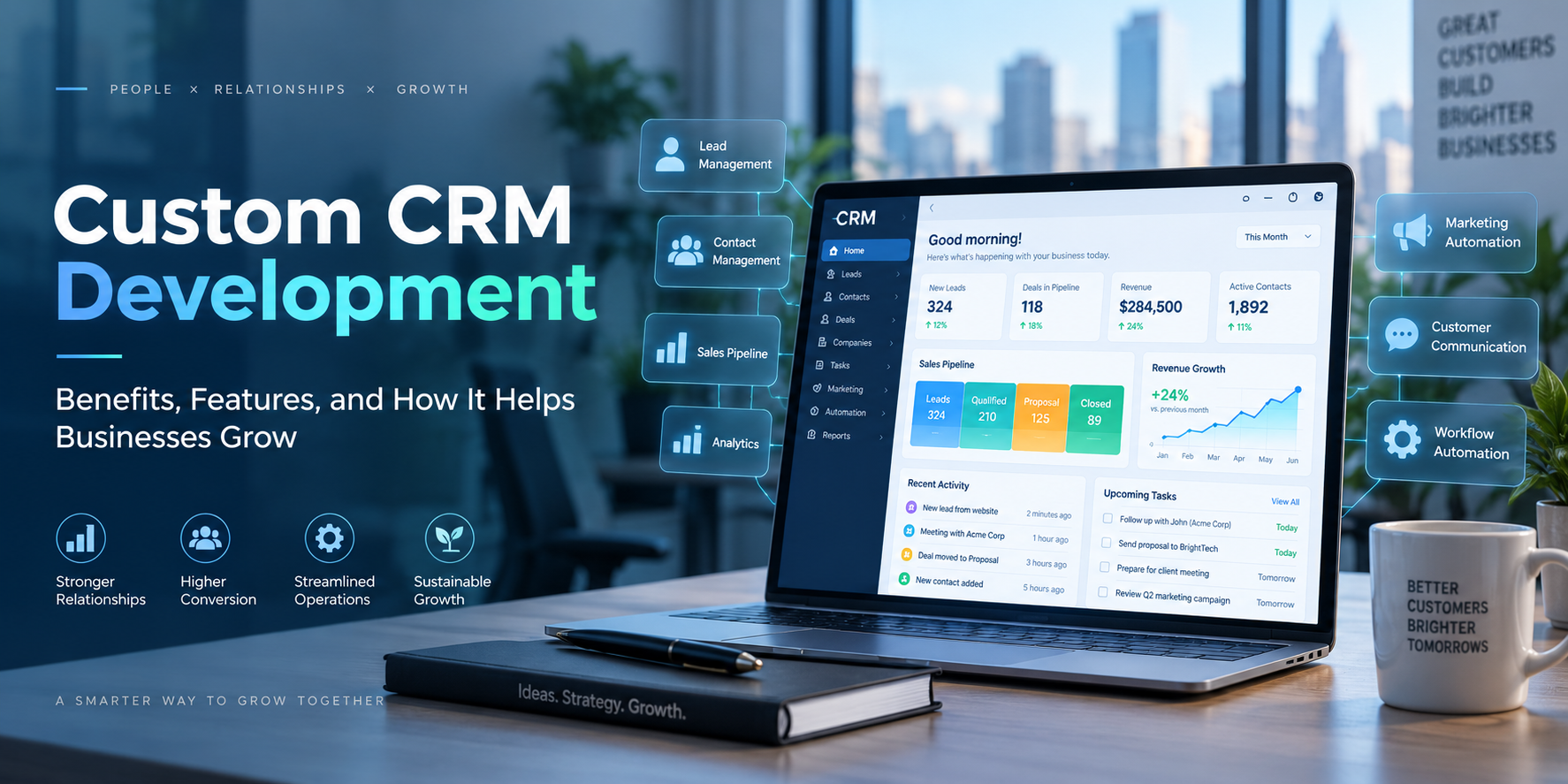
Custom CRM Development: Benefits, Features, and How It Helps Businesses Grow
As businesses expand, managing customer relationships through spreadsheets, disconnected tools, and manual processes becomes increasingly difficult. Sales teams may use one platform, customer service may rely on another, while marketing data is stored separately. This fragmented approach can lead to missed opportunities, duplicated information, inconsistent customer experiences, and limited visibility into the sales pipeline.
This is where custom CRM development becomes valuable.
Custom CRM development involves designing and building a Customer Relationship Management system around the specific processes, customer journeys, and operational needs of a business. Instead of adapting to a generic software package, companies can create a CRM platform that reflects the way their teams actually work.
For growing organizations, a custom CRM system can support better customer management, stronger sales processes, improved communication, and more informed decision-making.
What Is Custom CRM Development?
Custom CRM development is the process of creating a tailored Customer Relationship Management platform for a specific business.
A CRM system helps organizations manage customer information, sales activities, communication history, leads, opportunities, support interactions, and other relationship-related data in one place.
A custom CRM may include features such as:
Lead management Contact management Sales pipeline tracking Customer communication history Task and activity management Marketing automation Customer support integration Reporting and analytics Workflow automation Role-based dashboards * Third-party integrations
Unlike off-the-shelf CRM platforms, a custom CRM can be designed around the exact workflows, departments, approval processes, and reporting requirements of the organization.
Key Benefits of Custom CRM Development
1. Built Around Your Sales Process
Every business has a different sales model.
Some companies have short sales cycles, while others require multiple meetings, approvals, proposals, negotiations, and follow-ups before closing a deal.
A custom CRM system can be designed around these specific stages.
For example, a company may define a sales pipeline that includes:
New lead Qualified lead Consultation Proposal sent Negotiation Closed won * Closed lost
Instead of forcing employees to use generic pipeline stages, the CRM can reflect the company’s actual sales process.
This can make the system easier to use and provide management with more accurate insights into sales activity.
2. Centralized Customer Information
Customer data is often stored across emails, spreadsheets, messaging platforms, sales tools, and customer support systems.
This can make it difficult for employees to understand the complete history of a customer relationship.
A custom CRM can bring this information into one centralized system.
Sales representatives may be able to view:
Contact information Previous conversations Purchase history Quotes and proposals Support requests Meetings Follow-up tasks Current sales opportunities
Having this information available in one place can improve collaboration between departments and reduce the risk of losing important customer details.
3. Improved Lead Management
Generating leads is only the first step in the sales process.
Businesses also need an effective method for tracking, qualifying, assigning, and following up with potential customers.
Custom CRM development can create lead management workflows that match the organization’s strategy.
For example, new leads from website forms can automatically enter the CRM and be assigned to the appropriate salesperson.
The system may also classify leads according to factors such as location, service interest, company size, source, or sales potential.
Automated reminders can then help sales teams follow up with leads at the right time.
This structured approach can reduce missed opportunities and improve the efficiency of the sales process.
4. Better Sales Pipeline Visibility
A clear sales pipeline helps businesses understand how many opportunities exist and where they are within the sales process.
A custom CRM can provide dashboards that show:
Number of active opportunities Potential deal value Conversion rates Average sales cycle Sales performance by employee Lead sources * Won and lost deals
These insights can help managers identify bottlenecks and understand which sales activities are producing the strongest results.
Better pipeline visibility also supports more accurate forecasting and planning.
5. Increased Sales Team Productivity
Sales employees often spend significant time on administrative tasks.
They may manually enter customer information, update spreadsheets, prepare follow-up lists, or search through previous emails.
Custom CRM development can automate many of these activities.
Automation may include:
Lead assignment Follow-up reminders Email notifications Task creation Deal status updates Sales reports Customer segmentation Data synchronization
Reducing repetitive work allows sales teams to spend more time speaking with prospects and developing customer relationships.
Essential Features of a Custom CRM System
The exact features depend on the organization, but several capabilities are commonly valuable.
Contact and Account Management
A CRM should provide a structured view of customers and organizations.
Customer profiles may include contact details, account information, purchase history, communication records, documents, and sales opportunities.
This provides employees with a more complete understanding of each customer relationship.
Lead and Opportunity Management
Lead and opportunity management allows sales teams to track prospects throughout the sales journey.
The CRM can record lead sources, qualification status, expected deal value, next actions, and probability of closing.
Businesses can also create custom pipeline stages based on their own processes.
Task and Activity Tracking
Sales success often depends on consistent follow-up.
A custom CRM can help teams manage calls, meetings, emails, demonstrations, proposals, and follow-up activities.
Employees can view upcoming tasks and receive reminders when action is required.
Marketing Automation
CRM systems can also support marketing activities.
For example, businesses may use customer data to segment audiences and create targeted campaigns.
The CRM may integrate with email marketing, advertising, social media, or marketing automation platforms.
This can help businesses connect marketing activity with actual sales outcomes.
Customer Service Integration
The relationship with a customer does not end after a sale.
Custom CRM solutions can integrate with customer support systems to provide a more complete customer view.
Sales and service teams can access relevant information about previous purchases, support cases, complaints, and communication history.
This can contribute to a more consistent customer experience.
Reporting and Analytics
Data becomes more valuable when it can be transformed into useful insights.
A custom CRM may provide reports on:
Lead conversion rates Sales revenue Customer acquisition Sales team performance Marketing sources Deal progression Customer retention Lost opportunities
These reports can help management evaluate performance and identify areas for improvement.
Custom CRM vs. Off-the-Shelf CRM
Ready-made CRM systems can be effective for many businesses.
Popular platforms often include a wide range of standard features and can be implemented relatively quickly.
However, they may also include functionality that the business does not need, while lacking certain specialized features.
Custom CRM development provides greater flexibility.
The organization can determine how the platform looks, how workflows operate, what information is collected, and how the CRM integrates with other systems.
The right approach depends on factors such as:
Business complexity Sales process Number of users Required integrations Budget Security requirements Reporting needs Long-term growth plans
Smaller organizations with standard sales processes may benefit from ready-made software, while businesses with specialized requirements may gain more value from a custom CRM solution.
How Custom CRM Development Helps Businesses Grow
A well-designed CRM supports growth by helping organizations manage increasing numbers of leads and customers without losing visibility or control.
As customer volume grows, manual management becomes more difficult.
A CRM creates structure around customer relationships.
It allows businesses to identify high-value opportunities, understand customer behavior, improve follow-up, and measure sales performance.
Custom CRM systems can also support expansion into new markets or service areas.
New teams, products, sales stages, and integrations can be added as business requirements evolve.
This scalability helps prevent the CRM from becoming a limitation as the organization grows.
How to Choose the Right Custom CRM Solution
Choosing the right CRM should begin with a clear understanding of business requirements.
Organizations should identify current problems before discussing technology.
Questions may include:
Where is customer information currently stored? Which steps in the sales process are inefficient? What information do sales teams need? Which reports does management require? What systems need to be integrated? Which tasks should be automated?
It is also important to involve the employees who will use the CRM.
Sales, marketing, customer service, and management may have different requirements.
A reliable CRM development company should understand both technology and business processes.
Important capabilities may include:
Business process analysis UX and interface design Database development API integrations Automation Security Cloud infrastructure Analytics * Scalability
The implementation process should also include testing, data migration, employee training, and post-launch support.
The Importance of User Experience in CRM Development
A CRM is only valuable if employees use it consistently.
A complicated system may cause employees to avoid updating records, which reduces data quality and limits the value of the platform.
The interface should therefore be simple, clear, and aligned with real employee workflows.
Role-based dashboards can also improve usability.
For example, a salesperson may need quick access to leads, opportunities, and follow-up tasks, while a sales manager may focus on team performance, forecasts, and pipeline reports.
A user-friendly CRM can improve adoption and reduce training requirements.
Security in Custom CRM Development
CRM systems contain valuable customer and business information.
This may include names, phone numbers, email addresses, sales records, contracts, and communication history.
Security should therefore be considered throughout the development process.
Important measures may include:
Role-based permissions Secure authentication Data encryption Activity logs Regular backups API security Access controls System monitoring
Businesses should also establish clear procedures for software updates, account management, and data protection after launch.
Conclusion
Custom CRM development gives businesses the ability to create a customer management platform around their specific sales processes, teams, and growth objectives.
A well-designed custom CRM can centralize customer information, improve lead management, automate repetitive tasks, provide better sales visibility, and support stronger collaboration between sales, marketing, and customer service teams.
It can also help businesses scale more effectively by creating structured processes for managing increasing numbers of leads and customers.
However, successful CRM development requires more than technical implementation.
Businesses should clearly define their requirements, involve the people who will use the system, prioritize usability, plan integrations carefully, and select a development partner that understands both software and business operations.
When implemented effectively, a custom CRM can become more than a customer database. It can serve as a central platform for managing relationships, improving sales performance, and supporting sustainable business growth.