
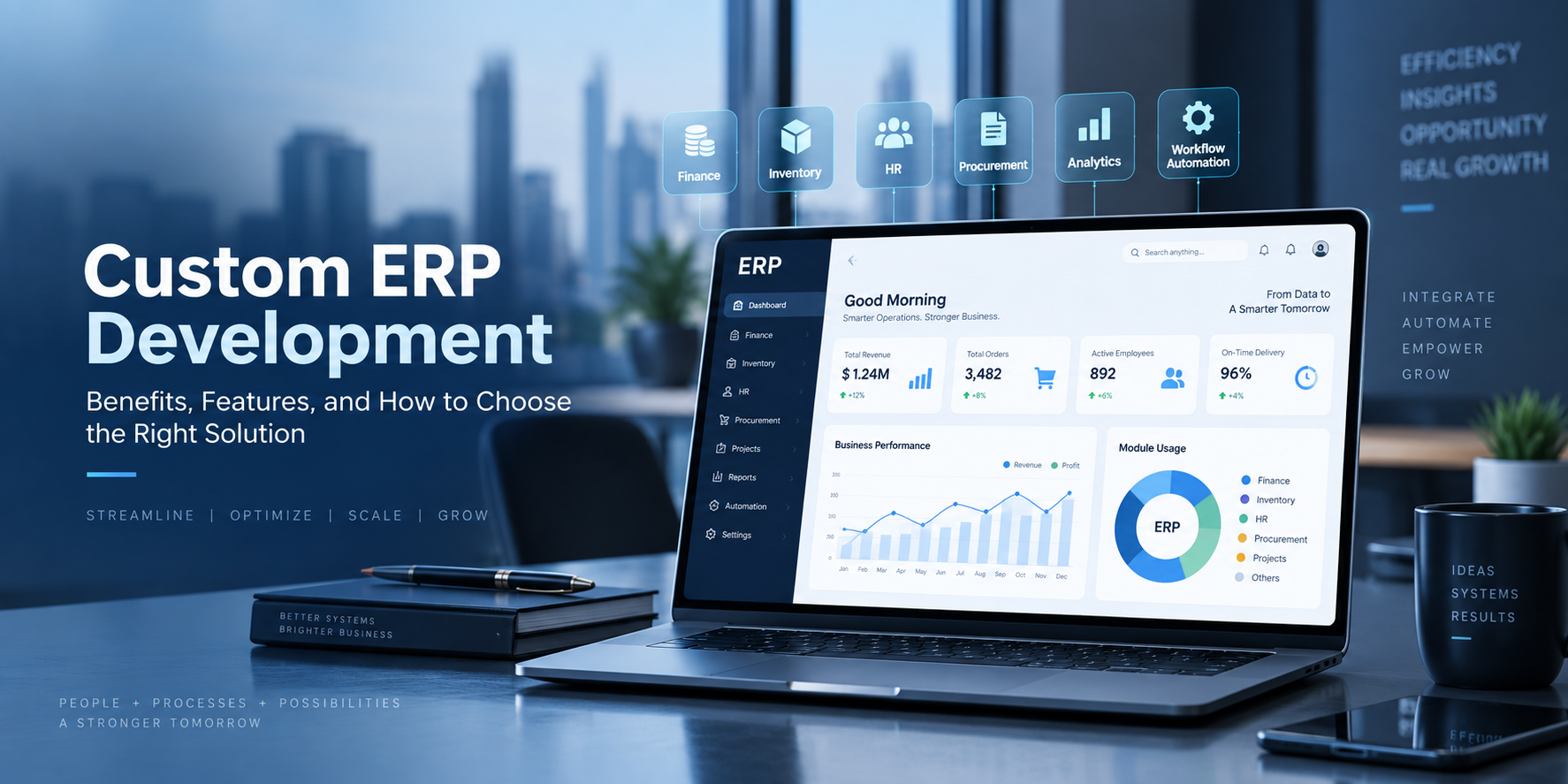
Custom ERP Development: Benefits, Features, and How to Choose the Right Solution
As businesses grow, managing operations through disconnected spreadsheets, separate software tools, and manual processes becomes increasingly difficult. Finance teams may use one system, sales teams another, while inventory, procurement, human resources, and customer service operate on separate platforms.
This lack of integration can lead to duplicated work, inaccurate data, slower decision-making, and reduced operational efficiency.
This is where custom ERP development can provide significant value.
A custom Enterprise Resource Planning system is designed specifically around the processes, structure, and requirements of a particular organization. Rather than forcing a business to adapt to a generic software package, custom ERP development creates a centralized platform that supports the way the business actually operates.
For companies with complex workflows, multiple departments, or long-term digital transformation goals, a custom ERP solution can become an essential part of the organization’s infrastructure.
What Is Custom ERP Development?
Custom ERP development refers to the process of designing and building an Enterprise Resource Planning system according to the specific operational requirements of a business.
An ERP system usually connects several business functions within one platform, allowing departments to share information and work with the same data.
A custom ERP may include modules for:
Accounting and finance Inventory management Procurement Sales management Human resources Payroll Customer management Supply chain operations Project management Reporting and analytics
Unlike off-the-shelf ERP software, a custom system can be developed around existing business processes, approval structures, reporting requirements, and industry-specific needs.
This level of flexibility is one of the main reasons organizations consider custom ERP development.
Key Benefits of Custom ERP Development
1. Designed Around Your Business Processes
Every organization has its own workflows.
A manufacturing company may need production planning and warehouse management, while a professional services company may focus more heavily on project management, employee utilization, and billing.
Custom ERP development allows the system to reflect these specific requirements.
Instead of changing internal processes to fit standard software, businesses can build the platform around their existing operational structure.
This can improve usability and reduce unnecessary steps in daily workflows.
2. Centralized Business Data
One of the most important advantages of an ERP system is data centralization.
When different departments use separate tools, information may be duplicated or become inconsistent.
For example, sales records may not match accounting records, while inventory information may not reflect actual stock levels.
A custom ERP system can connect these departments through a shared database.
This creates a single source of information across the organization.
As a result, managers and employees can access more consistent and up-to-date data when making decisions.
3. Improved Operational Efficiency
Manual tasks can consume significant time and increase the possibility of errors.
A custom ERP solution can automate many repetitive processes.
Examples may include:
Generating invoices Updating inventory levels Creating purchase orders Calculating payroll Sending approval requests Producing financial reports Tracking employee attendance Updating customer information
Automation can reduce administrative workload and allow employees to focus on higher-value activities.
It can also help organizations create more consistent processes across departments.
4. Better Reporting and Decision-Making
Reliable data is essential for effective management.
Custom ERP systems can include dashboards and reporting tools specifically designed for the organization.
Management may monitor indicators such as:
Revenue Expenses Profit margins Inventory levels Sales performance Employee productivity Outstanding payments Procurement costs
Because data is collected from different departments within the same platform, reports can provide a more complete view of business performance.
This can support faster and more informed decision-making.
5. Scalability for Business Growth
Business requirements rarely remain the same.
As a company grows, it may add employees, departments, products, warehouses, branches, or new markets.
A well-designed custom ERP system can be built with scalability in mind.
Businesses may start with essential modules and add new functionality over time.
For example, an organization might begin with accounting, sales, and inventory management before later introducing human resources, customer relationship management, or advanced analytics.
This flexibility can help the ERP platform evolve alongside the business.
Essential Features of a Custom ERP System
The exact features of an ERP system depend on the organization, but several capabilities are commonly important.
Financial Management
Financial management is often one of the central ERP functions.
The system may support accounting, budgeting, expenses, invoicing, payment tracking, taxation, and financial reporting.
Integrating financial data with other departments can provide greater visibility into the company's overall performance.
Inventory and Warehouse Management
Businesses that sell or distribute physical products require accurate inventory information.
ERP systems can help track stock levels, warehouse movements, purchase orders, product availability, and supplier information.
Real-time inventory visibility can help reduce both shortages and excessive stock.
Sales and Customer Management
ERP platforms can also support sales processes.
Sales teams may manage quotations, orders, pricing, customer records, and sales reports through the system.
When connected with other modules, a sales transaction can automatically update inventory and financial records.
Human Resources and Payroll
Custom ERP systems may include employee management features such as:
Employee records Attendance Leave management Payroll Performance information Recruitment data
This can help HR teams reduce manual administration and maintain more structured employee information.
Workflow Automation
Approval workflows are particularly valuable for organizations with structured processes.
For example, purchase requests may need approval from department managers before being sent to procurement.
A custom ERP can automatically route requests to the correct employees and record each step of the approval process.
Reporting and Analytics
Dashboards and reports allow businesses to convert operational data into useful insights.
Custom ERP development allows reports to be designed according to specific management requirements rather than relying only on standard reports provided by commercial software.
Custom ERP vs. Off-the-Shelf ERP
Both custom and ready-made ERP systems have advantages.
Off-the-shelf ERP software may be suitable for companies with relatively standard processes. It can usually be implemented faster because many features already exist.
However, organizations may need to adapt their processes to the software.
Custom ERP development takes a different approach.
The system is designed specifically around the business.
This provides greater flexibility but usually requires more planning, development, testing, and investment.
Therefore, businesses should evaluate factors such as:
Operational complexity Required integrations Budget Implementation timeline Number of users Future growth * Industry-specific requirements
The right choice depends on the organization's priorities.
How to Choose the Right Custom ERP Solution
Choosing an ERP solution is a strategic decision because the platform may influence daily operations across the entire company.
The first step is to clearly define business requirements.
Organizations should identify existing challenges, inefficient processes, reporting needs, and integration requirements.
It is also important to involve employees from different departments.
Finance, HR, sales, operations, and management may all have different expectations from the system.
Businesses should also evaluate the technical experience of the ERP development company.
A reliable development partner should understand:
Business process analysis Database architecture System security User experience API integrations Cloud infrastructure Reporting and analytics Scalability
The project should also include a clear implementation plan.
This normally includes requirements analysis, system architecture, interface design, development, data migration, testing, employee training, and deployment.
The Importance of User Experience in ERP Development
ERP systems are used by employees on a daily basis.
Therefore, user experience should not be treated as a secondary consideration.
An ERP system may contain powerful features, but if employees find it confusing or difficult to use, adoption may become a challenge.
Clear navigation, simple dashboards, logical workflows, and role-based interfaces can make the system easier to use.
For example, finance employees should see information relevant to financial activities, while warehouse employees should have quick access to inventory and stock functions.
Designing the interface around real user responsibilities can improve productivity and reduce training requirements.
Security in Custom ERP Development
ERP systems often contain sensitive business information.
This may include financial data, employee records, supplier information, customer details, and internal reports.
Security should therefore be considered from the beginning of the development process.
Important measures may include:
Role-based access control Data encryption Secure authentication Regular backups Activity logs API security Database protection System monitoring
Organizations should also establish clear procedures for system updates and security maintenance after launch.
Conclusion
Custom ERP development allows businesses to build a centralized digital system around their unique operational requirements.
Instead of relying on disconnected tools or adapting complex workflows to standard software, organizations can create an ERP platform that connects departments, automates processes, improves reporting, and supports long-term growth.
The main benefits include greater operational efficiency, centralized data, improved decision-making, better automation, and scalability.
However, successful ERP development requires careful planning.
Businesses should clearly define their needs, involve key departments, prioritize user experience, and choose a development partner with strong technical and business expertise.
When properly designed and implemented, a custom ERP solution can become much more than business software. It can serve as a digital foundation that connects people, processes, and data across the entire organization.