
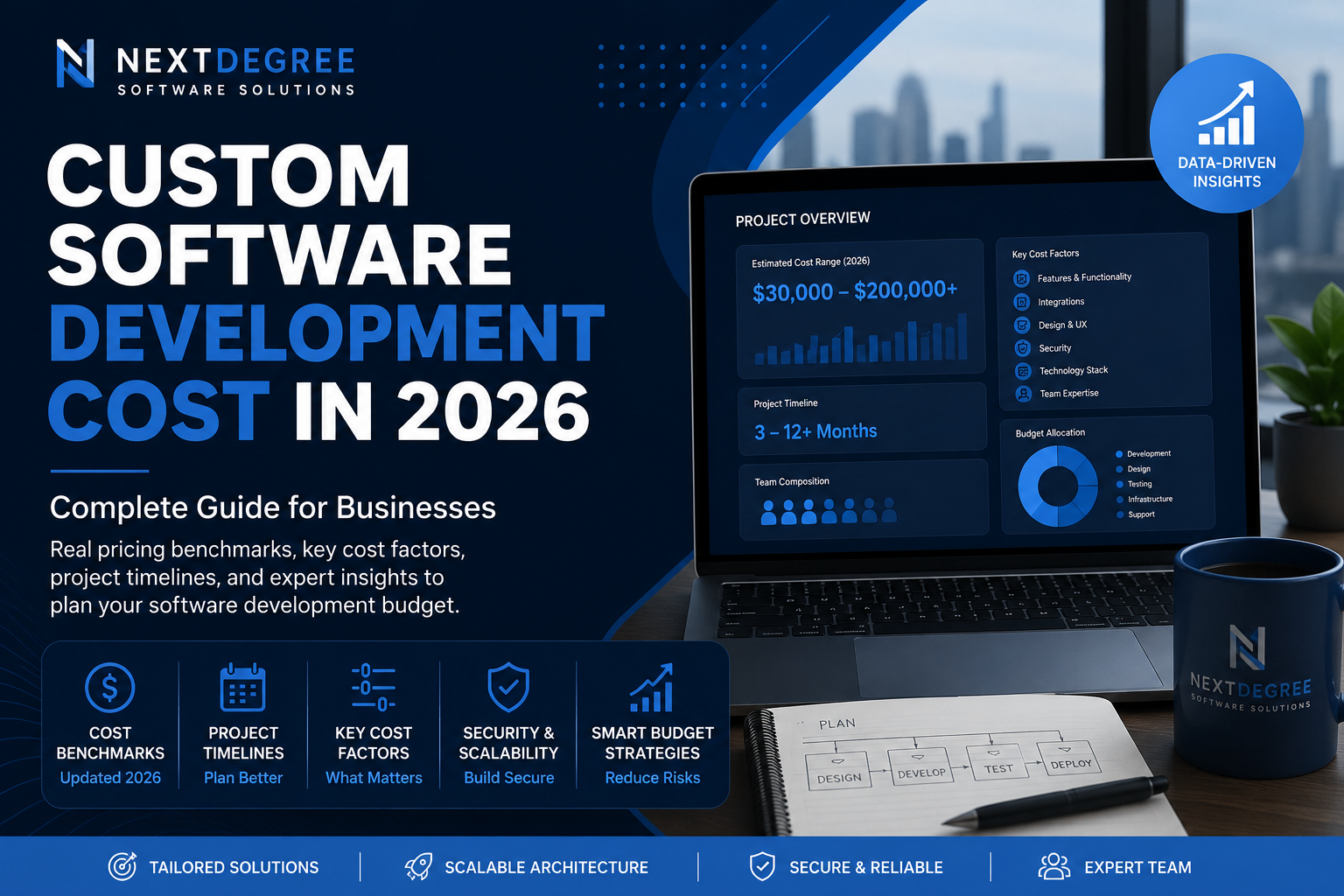
Custom Software Development Cost in 2026: Complete Guide for Businesses
Last updated: August 2026
Custom software can transform how a business operates, but one question usually comes before development begins: How much does custom software development cost?
There is no single price that applies to every project. In 2026, the cost of custom software development depends on the complexity of the product, number of features, integrations, security requirements, technology stack, development team, infrastructure, and long-term support needs.
A focused MVP may require a relatively modest investment, while an enterprise platform involving complex workflows, multiple integrations, advanced security, artificial intelligence, or high transaction volumes can require a significantly larger budget.
This guide explains the factors that determine custom software development costs in 2026, how companies estimate projects, where businesses commonly overspend, and how to plan a software budget effectively.
What Is Custom Software Development?
Custom software development is the process of designing, building, testing, deploying, and maintaining software created around the specific requirements of a business or organization.
Unlike off-the-shelf software, which is designed for a broad audience, custom software can be engineered around an organization's existing processes, users, integrations, security requirements, and growth plans.
Examples include:
Enterprise management platforms Customer portals Custom CRM and ERP systems Fintech and payment platforms Digital wallets Workflow automation systems AI-powered business applications SaaS platforms Mobile applications Internal dashboards * API and system integrations
The objective is not simply to create software. A successful custom solution should solve a measurable business problem while remaining secure, maintainable, and capable of evolving as the organization grows.
How Much Does Custom Software Development Cost in 2026?
The cost of custom software development can range from tens of thousands of dollars for a focused application to hundreds of thousands of dollars or more for complex enterprise platforms.
Rather than relying on a universal price, businesses should evaluate the scope and engineering requirements of the individual project.
A useful way to think about project size is:
| Project Type | Typical Complexity | Examples | | -------------------- | ------------------ | ------------------------------------------------------ | | Focused MVP | Low–Medium | Customer portal, internal tool, simple marketplace | | Business Application | Medium | CRM, workflow platform, mobile application | | Advanced Platform | Medium–High | SaaS product, multi-role marketplace, AI platform | | Enterprise System | High | ERP, multi-system integration, large business platform | | Fintech Platform | High | Digital wallet, payment system, financial platform |
These categories are more useful than fixed price promises because two applications that appear similar to users may have completely different backend, integration, security, and scalability requirements.
What Determines Custom Software Development Cost?
Several factors have a direct impact on the final development budget.
1. Project Scope and Complexity
Complexity is usually the largest cost driver.
A basic internal dashboard may require authentication, user management, several forms, reports, and a database.
A larger enterprise platform could require:
Multiple user roles and permission levels Complex approval workflows Real-time notifications External integrations Advanced analytics Payment processing Multi-language support Audit trails Mobile applications High availability * Advanced security controls
Every additional requirement introduces design, engineering, testing, and maintenance work.
This is why defining the minimum viable product (MVP) before development is often one of the best ways to control cost.
2. Number and Complexity of Features
Software cost is strongly influenced by what the system must actually do.
Features such as basic authentication or content management are generally less complex than:
Real-time communication Payment processing Recommendation engines Computer vision Machine learning Complex reporting Geolocation Workflow automation Multi-tenant SaaS architecture Financial reconciliation
Businesses should therefore prioritize features according to business value rather than trying to include every possible capability in the first release.
3. UI and UX Design
User experience can significantly affect adoption.
A simple administrative system may only require a clean, functional interface. A customer-facing SaaS platform or mobile application may require extensive UX research, wireframes, prototypes, design systems, accessibility considerations, and responsive interfaces.
Professional UI/UX work typically includes:
- User research
- User journeys
- Information architecture
- Wireframes
- Interactive prototypes
- Visual design
- Responsive behavior
- Usability validation
Investing in UX early can also reduce expensive redesign work later in development.
4. Web, Mobile, or Both
The platforms being developed also affect the budget.
A web application alone is generally different in scope from an ecosystem containing:
Web application + Android app + iOS app + administration dashboard + backend APIs.
Businesses can sometimes reduce mobile development effort by using cross-platform technologies such as Flutter or React Native, but the correct choice depends on the product's performance, functionality, device integration, and long-term requirements.
5. Backend Architecture
Users rarely see backend infrastructure, but it can represent a substantial part of software engineering.
The backend may need to manage:
Authentication Authorization Business logic Databases APIs File storage Notifications Search Background jobs Caching Message queues Audit logging * Third-party integrations
An application designed for a few hundred users also has different infrastructure requirements from a platform expected to process millions of requests or large volumes of financial transactions.
Architecture should therefore reflect realistic growth requirements rather than unnecessary complexity or short-term thinking.
6. Third-Party Integrations
Modern business software rarely operates completely independently.
Common integrations include:
Payment gateways Banking APIs ERP platforms CRM systems Email services SMS providers Identity providers Cloud storage Analytics tools Shipping providers Accounting systems Government or enterprise APIs
Integration cost depends heavily on the quality of the external API, documentation, authentication requirements, testing environment, and business rules.
Poorly documented legacy systems can require substantially more engineering effort than modern standardized APIs.
7. Security Requirements
Security should be considered from the beginning of software architecture, particularly for applications handling sensitive business, identity, healthcare, or financial information.
Security requirements may include:
Encryption in transit Encryption at rest Role-based access control Multi-factor authentication Secure credential management Audit logs Rate limiting Vulnerability management Backup and disaster recovery Secure API design * Security monitoring
Applications in regulated industries may require additional compliance controls and documentation.
Security should therefore be included in the original project estimate rather than treated as an optional feature added after development.
8. Artificial Intelligence and Machine Learning
AI functionality can significantly change project scope.
AI software development may involve:
Data collection and preparation Model selection Model training Computer vision Natural language processing Recommendation systems Predictive analytics Generative AI integrations Model evaluation AI infrastructure * Monitoring and continuous improvement
However, not every AI application requires building a model from scratch.
In many cases, businesses can integrate existing AI models or APIs into a custom application, potentially reducing development time and infrastructure requirements.
The appropriate approach depends on the problem, available data, privacy requirements, expected accuracy, and operating cost.
9. Development Team
Software is typically delivered by a multidisciplinary team.
Depending on the project, this can include:
Product manager Business analyst UI/UX designer Frontend developer Backend developer Mobile developer AI/ML engineer DevOps engineer QA engineer Security specialist * Technical architect
A small MVP does not necessarily require every role full-time.
Larger platforms usually require greater specialization and coordination.
10. Testing and Quality Assurance
Testing is essential for reliable production software.
Quality assurance can include:
Functional testing — Does the feature behave correctly?
Integration testing — Do connected systems communicate correctly?
Performance testing — Can the platform handle expected workloads?
Security testing — Are important vulnerabilities addressed?
Compatibility testing — Does the product operate across supported browsers and devices?
Regression testing — Did new development break existing functionality?
Reducing testing to lower the initial budget can create substantially greater costs after launch.
Fixed Price vs Time and Materials
Businesses commonly encounter two commercial models.
Fixed-Price Development
A fixed-price model works best when the project requirements and acceptance criteria are well defined.
Advantages:
Predictable initial budget Defined scope * Clear deliverables
Limitations:
Less flexibility Scope changes require formal adjustments * Difficult for highly exploratory products
Time and Materials
With time and materials, the business pays according to the engineering effort required.
This can work well for:
Complex platforms Evolving products Startup products AI projects Long-term development Projects where requirements will change after user feedback
The best model depends on how much uncertainty exists at the beginning of the project.
MVP vs Full Product: Which Is Better?
For many new products, developing an MVP first can reduce risk.
An MVP contains enough functionality to validate the core business proposition with real users.
Instead of immediately developing:
50 features + multiple mobile apps + AI + advanced analytics + dozens of integrations
a company might initially launch:
Core workflow + essential dashboard + critical integration + basic reporting.
Real user feedback can then guide subsequent development.
This approach helps prevent businesses from spending significant budgets on features customers ultimately do not need.
Hidden Costs Businesses Should Consider
The initial development quote is not necessarily the complete lifetime cost of software.
Businesses should also budget for:
Cloud Infrastructure
Servers, databases, storage, backups, monitoring, CDN services, and related cloud resources.
Third-Party Services
Payment providers, email platforms, SMS services, maps, AI APIs, analytics tools, and other services may charge according to usage.
Maintenance
Software requires security updates, dependency upgrades, bug fixes, infrastructure maintenance, and compatibility updates.
New Features
Successful products evolve as users and business requirements change.
Scaling
Infrastructure requirements can increase significantly as usage grows.
The correct question is therefore not only:
“How much will development cost?”
but also:
“What will this software cost to operate and evolve over the next three to five years?”
How to Reduce Custom Software Development Costs
Reducing cost does not mean choosing the cheapest development team.
A better strategy is to eliminate unnecessary engineering.
Start With Discovery
Document the business problem before selecting technology.
Define an MVP
Separate essential features from desirable future features.
Prioritize Integrations
Only integrate external systems that create measurable value.
Use Proven Technologies
Avoid introducing unnecessary technical complexity.
Design for Realistic Scale
A platform should be scalable, but engineering for hundreds of millions of users before acquiring the first thousand can waste significant resources.
Test Early
Problems found during design or development are generally easier to correct than problems discovered after production launch.
Build in Phases
Breaking a large transformation into controlled releases can reduce both technical and financial risk.
How Long Does Custom Software Development Take?
Development timelines vary according to project scope and complexity.
A focused MVP may take several months, while sophisticated enterprise, fintech, or AI platforms may require significantly longer development cycles.
A typical lifecycle includes:
Discovery → Architecture → UX/UI → Development → Testing → Deployment → Monitoring → Continuous Improvement
Attempting to shorten a project simply by increasing the number of developers does not always work. Larger teams also introduce additional communication and coordination overhead.
A realistic project plan should therefore be based on scope and dependencies rather than an arbitrary launch date.
How to Choose a Custom Software Development Company
Cost should be one consideration—not the only consideration.
Evaluate potential software partners according to:
Technical expertise
Can the team demonstrate expertise in the technologies required by the project?
Architecture capabilities
Can they explain how the system will remain secure, maintainable, and scalable?
Business understanding
Do they understand the problem before proposing a technology?
Communication
Is there a transparent process for requirements, progress, risks, and changes?
Security
Is security incorporated into architecture and development?
DevOps capabilities
Can the team reliably deploy, monitor, maintain, and scale the software?
Relevant experience
Look for credible examples involving similar technical or business challenges.
Post-launch support
Understand who will maintain the system after production release.
A low initial quote can become expensive if the product later requires substantial rewriting.
Is Outsourcing Software Development to Egypt Cost-Effective?
Egypt has become an increasingly relevant software engineering location for organizations looking for technical talent and regional delivery capabilities.
For businesses in the Middle East, working with an Egyptian development team can also offer practical advantages such as compatible time zones and familiarity with regional business requirements.
However, location alone should never determine vendor selection.
Companies should evaluate engineering quality, communication, security practices, architecture capabilities, project management, relevant experience, and long-term support before selecting a development partner.
Custom Software Development at NextDegree
NextDegree Software Solutions designs and develops custom digital products for businesses with requirements that cannot be solved effectively through standard off-the-shelf platforms.
Our engineering capabilities include:
Custom software development Enterprise platforms Web and mobile applications AI and automation Fintech and payment systems SaaS development System integrations Cloud infrastructure DevOps Application modernization
Our approach begins with understanding the business problem and technical requirements before determining architecture, technologies, scope, and delivery phases.
For projects with uncertain or extensive requirements, development can be divided into controlled phases—allowing the organization to validate priorities before committing to unnecessary functionality.
Frequently Asked Questions
How much does custom software development cost in 2026?
Custom software development costs vary widely. A focused business application may cost tens of thousands of dollars, while sophisticated enterprise, fintech, AI, or high-scale platforms can reach hundreds of thousands of dollars or more. Complexity, integrations, security, team requirements, and infrastructure are major cost factors.
What affects the cost of custom software development?
The main factors include project scope, number and complexity of features, UI/UX requirements, backend architecture, mobile applications, third-party integrations, security, infrastructure, testing, AI functionality, and ongoing support.
Is custom software more expensive than SaaS?
Custom software generally requires a larger initial investment than subscribing to an existing SaaS platform. However, it provides greater control over workflows, integrations, functionality, and product evolution. The right option depends on the business requirements and long-term economics.
How long does it take to develop custom software?
A focused MVP can take several months, while complex enterprise platforms may require longer development cycles. The timeline depends on scope, integrations, security, design requirements, testing, and the number of platforms being developed.
Should a startup build an MVP first?
In many cases, yes. An MVP allows a startup to validate its core product assumptions with users before investing in a complete feature set. However, the appropriate approach depends on the product, market, regulatory requirements, and technical dependencies.
Can existing business software be modernized instead of rebuilt?
Yes. Depending on its architecture and technical condition, existing software may be modernized incrementally through refactoring, API development, infrastructure migration, UI modernization, database improvements, or replacement of individual components.
How do I choose a custom software development company?
Evaluate engineering expertise, relevant project experience, architecture capabilities, security practices, communication, project-management processes, DevOps capabilities, testing practices, and post-launch support—not simply the lowest quote.
Can custom software integrate with our existing ERP or CRM?
Usually, yes, provided the existing platform offers suitable APIs, database access, integration mechanisms, or other supported interfaces. Integration complexity depends heavily on the existing system and its documentation.
Final Thoughts
The cost of custom software development in 2026 cannot be accurately determined from a generic price list.
The right budget depends on what the software must accomplish, who will use it, which systems it must integrate with, how securely it must operate, and how far it needs to scale.
For businesses considering custom software, the most effective first step is therefore not asking:
“What is the cheapest way to build this?”
Instead, ask:
“What is the smallest reliable solution that solves our highest-value business problem and gives us a foundation for future growth?”
That question leads to better architecture, better budget decisions, and ultimately better software.
Planning a custom software project? NextDegree can help you evaluate the requirements, architecture, development scope, and delivery approach before implementation.