
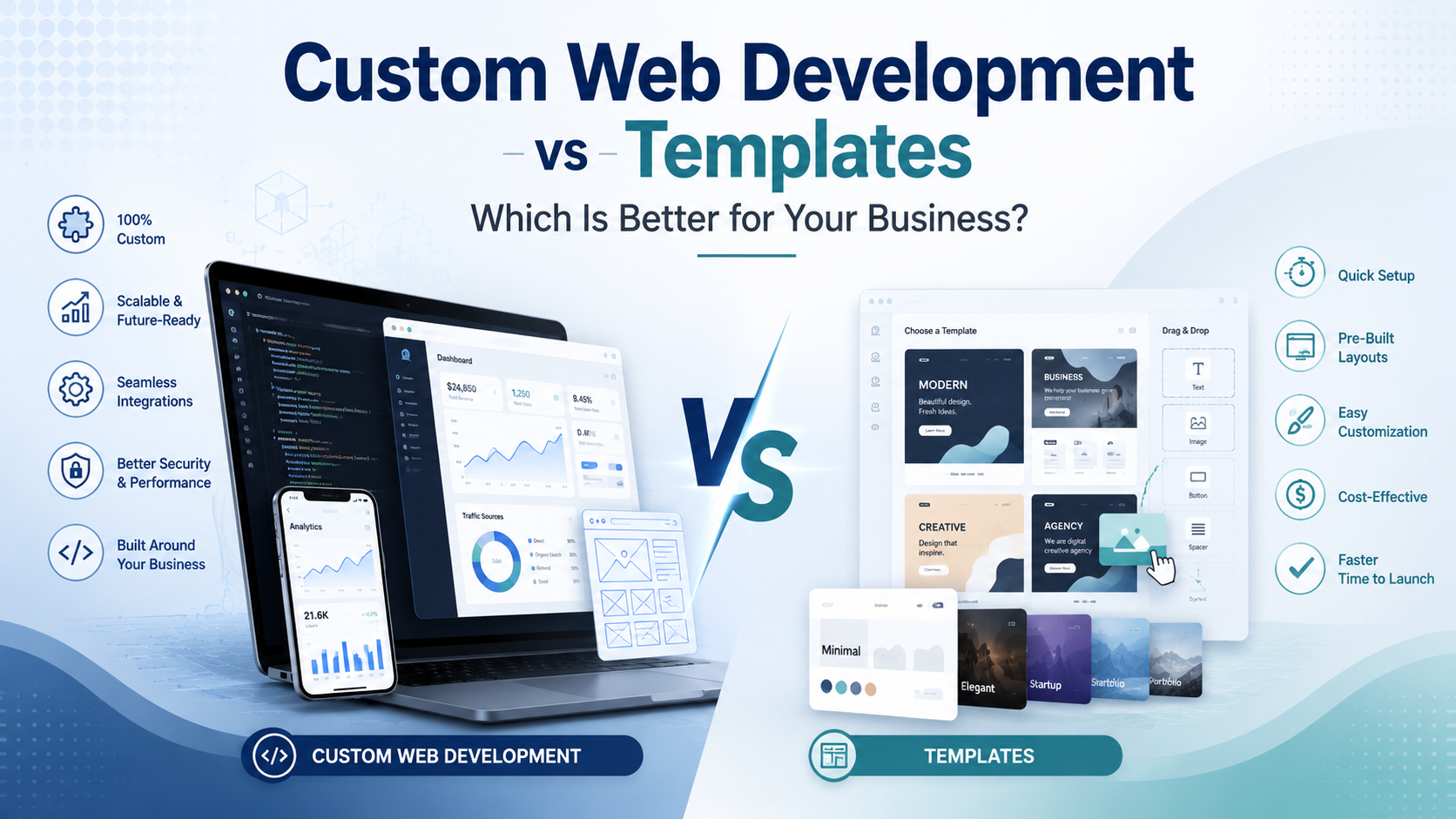
Custom Web Development vs Templates: Which Is Better for Your Business?
Choosing how to build a business website is one of the most important digital decisions a company can make. A website is no longer simply an online brochure. It often serves as a sales channel, customer service platform, lead-generation tool, brand asset, and central part of a company’s digital presence.
For many businesses, the decision comes down to two main options: [custom web development vs templates](https://www.nextdegree.tech/services/custom-software-development).
Template-based websites offer speed, affordability, and convenience. Custom web development offers greater flexibility, scalability, performance control, and long-term adaptability. Both approaches can be effective, but they serve different business needs.
The better option depends on factors such as budget, project complexity, business goals, required functionality, expected growth, branding requirements, and long-term digital strategy.
This guide compares custom web development vs templates in detail, explains the advantages and limitations of each approach, and helps you determine which option is more suitable for your business.
---
What Is Custom Web Development?
Custom web development is the process of building a website specifically around the needs, goals, processes, and technical requirements of a particular business.
Rather than starting with a predefined website structure, designers and developers create the website according to a tailored specification.
A custom website may include:
Unique page layouts Custom user interfaces Bespoke functionality Advanced integrations Custom databases Business-specific workflows Customer portals Booking systems Product configurators Advanced e-commerce functionality Internal dashboards Personalized user experiences
Custom development usually involves a combination of strategy, design, front-end development, back-end development, testing, deployment, and ongoing maintenance.
The goal is not simply to create a visually unique website. The objective is to build a digital platform that supports the specific operational and commercial needs of the organization.
---
What Is a Website Template?
A website template is a pre-designed structure that can be adapted with a business’s own content, branding, images, and selected features.
Templates are commonly available through content management systems and website-building platforms.
They usually include predefined:
Page layouts Navigation structures Color settings Typography options Header and footer styles Product pages Blog layouts Contact forms * Homepage sections
Instead of designing every part of the website from the beginning, a business selects a template and modifies it according to its needs.
This can significantly reduce both development time and cost.
Template-based websites are particularly common among:
Small businesses Startups Freelancers Personal brands Local service companies Small online stores * Businesses launching their first website
Templates can provide a practical starting point when advanced customization is not required.
---
Custom Web Development vs Templates: The Core Difference
The main difference between the two approaches is the level of control and customization.
Custom web development creates a website around the business, while a template requires the business to work within a predefined website structure.
This distinction affects almost every part of the project, including:
Cost Development time Design flexibility Functionality Scalability Performance Security Maintenance Search engine optimization User experience
Neither approach is automatically better.
The right choice depends on the needs of the business.
---
Advantages of Custom Web Development
Custom websites provide greater freedom and control, making them particularly suitable for businesses with complex requirements or long-term digital ambitions.
1. Greater Design Flexibility
A major advantage of custom development is the ability to create a website that closely reflects the company’s brand identity.
With a custom project, the business is not limited by the layout or structure of an existing template.
The design can be created around:
Brand positioning Customer expectations Conversion goals Content priorities User journeys Product requirements
This allows the final website to feel more distinctive and strategically aligned with the brand.
For businesses operating in competitive markets, this uniqueness can be valuable.
A website that looks similar to many competitors may struggle to create a strong impression, while a carefully designed custom experience can strengthen brand recognition and credibility.
---
2. Custom Functionality
Templates are designed to serve a broad range of users.
As a result, they generally focus on common website functions.
Custom development allows a business to create functionality that reflects its own processes.
Examples may include:
Dynamic pricing tools Complex booking systems Customer dashboards Subscription management Custom product builders Membership platforms Multi-step forms Automated workflows Inventory integrations Internal management systems
This can be particularly important when the website is directly connected to business operations.
For example, a company that needs a highly specialized quotation process may find that modifying a template becomes more complicated than building a custom solution.
---
3. Better Scalability
Scalability refers to the ability of a website to grow as the business grows.
A small business may begin with a simple website containing only a few pages. Over time, it may need:
Multiple languages More products Customer accounts New payment methods Advanced search Personalization Third-party integrations New business locations * Larger databases
A well-planned custom website can be designed with future growth in mind.
This does not mean that a custom website will never require redevelopment. However, the technical architecture can be structured to support expansion more effectively.
Templates can also scale, but businesses may eventually encounter limitations imposed by the original structure, plugins, or platform.
---
4. Greater Performance Control
Website performance affects both user experience and search visibility.
Custom development gives developers greater control over:
Code quality Image handling Scripts Database queries Caching Server configuration * Loading behavior
Templates often include functions that a specific business may never use.
This can sometimes result in unnecessary scripts, styles, or plugins being loaded.
Custom websites can be developed more selectively.
When implemented well, this can support faster loading times and more efficient performance.
However, it is important to note that custom development does not automatically guarantee a fast website. Poorly written custom code can still create performance problems.
Quality of implementation remains essential.
---
5. More Control Over Search Engine Optimization
Search engine optimization depends on many factors, including:
Content quality Site structure Internal linking Page speed Mobile usability Technical accessibility Structured data Crawlability
Custom development gives businesses greater control over technical SEO implementation.
Developers can create:
Customized URL structures Optimized page templates Structured data Technical redirects Internal linking systems Advanced metadata controls * Performance improvements
Template-based websites can also perform very well in search results, especially when using a reliable platform.
However, businesses with advanced SEO requirements may benefit from the additional technical flexibility of a custom solution.
---
6. Better Integration With Business Systems
Modern websites rarely operate independently.
A business website may need to connect with:
Customer relationship management systems Enterprise software Payment systems Accounting platforms Inventory systems Marketing automation tools Email platforms Logistics providers * Analytics systems
Custom web development makes it possible to design these integrations around the organization’s specific workflows.
This is especially valuable for medium and large businesses where the website is part of a wider technology ecosystem.
---
Disadvantages of Custom Web Development
Although custom development provides significant advantages, it also involves important trade-offs.
1. Higher Initial Cost
Custom websites usually require more planning, design, development, testing, and project management.
As a result, the upfront investment is typically higher than purchasing and adapting a template.
For a small business with limited requirements, this additional expense may not always be justified.
The decision should therefore be based on business value rather than simply choosing the most technically advanced option.
---
2. Longer Development Time
Custom projects take more time because the website must go through several stages.
These may include:
- Requirements analysis
- Strategy
- Information architecture
- User experience planning
- Visual design
- Development
- Testing
- Content implementation
- Launch
A template website can often be launched much faster because many of these elements are already prepared.
If speed is the primary requirement, a template may therefore be the more practical choice.
---
3. Greater Maintenance Requirements
Custom software requires ongoing maintenance.
This may involve:
Security updates Performance monitoring Software upgrades Bug fixes Server management Integration updates
Businesses should therefore consider not only the initial development budget but also the long-term cost of ownership.
---
Advantages of Website Templates
Templates have become extremely popular because they offer a practical way to create professional websites without developing everything from the beginning.
1. Lower Cost
One of the strongest advantages of templates is affordability.
A business can often purchase a professionally designed template at a relatively low cost.
The majority of the investment then goes toward:
Customization Content Branding Configuration * Hosting
This makes template websites particularly attractive to startups and small businesses.
---
2. Faster Launch
Templates significantly reduce development time because the basic structure already exists.
A business can often:
Install a template Add its logo Adjust colors Upload content Configure pages Add required plugins * Launch
For companies that need a website quickly, this can be a major advantage.
A startup validating a new idea, for example, may benefit more from launching quickly than investing heavily in custom development before confirming market demand.
---
3. Predictable Design
A template allows the business to see the general appearance of the website before development begins.
This can reduce uncertainty.
Businesses can review:
Page layouts Navigation Product displays Blog pages * Mobile versions
before selecting the template.
This is especially helpful for organizations without an internal design team.
---
4. Large Ecosystems of Features
Popular website platforms often provide access to extensive ecosystems of:
Plugins Applications Themes Payment integrations Marketing tools Analytics tools * Search engine optimization tools
This means businesses can add functionality without building every feature themselves.
For straightforward websites, this can be highly efficient.
---
5. Easier Content Management
Many template-based platforms are designed specifically for non-technical users.
Business owners and marketing teams may be able to update:
Text Images Blog articles Products Prices Promotions
without requiring a developer.
This can reduce ongoing operational costs.
---
Disadvantages of Website Templates
Templates are convenient, but they also create limitations.
1. Limited Customization
The main limitation is that the business must often work within the template’s existing structure.
While colors, images, fonts, and sections may be modified, deeper structural changes can become difficult.
In some cases, extensive customization of a template can become more complicated and expensive than developing a custom solution.
---
2. Similarity to Other Websites
Popular templates may be used by hundreds or even thousands of businesses.
As a result, websites can sometimes feel visually similar.
Strong branding, photography, typography, and content can reduce this problem, but achieving a completely distinctive experience may remain difficult.
---
3. Unnecessary Features
Templates are designed for many different users.
They may therefore include features that a particular business does not need.
These can create:
Extra scripts Additional styles Plugin dependencies Larger page sizes * More technical complexity
If poorly managed, this may affect performance.
---
4. Plugin Dependency
Template websites often rely heavily on plugins or third-party applications.
Plugins can be useful, but excessive dependency can introduce problems such as:
Compatibility conflicts Security vulnerabilities Performance issues Subscription costs * Limited control
Businesses should therefore evaluate the quality and reliability of the tools they install.
---
Custom Web Development vs Templates: Cost Comparison
Cost is one of the most important factors in the decision.
A template-based website usually has lower initial costs because much of the design and structure has already been developed.
Custom websites require more professional time.
However, businesses should evaluate total cost of ownership, not just initial cost.
For example, a template website may become expensive if the business later needs:
Extensive customizations Numerous premium plugins Complex integrations Frequent technical fixes * A complete redesign
Similarly, an expensive custom website may provide better long-term value if it supports important business processes and reduces operational inefficiencies.
The key question should therefore be:
Which option provides the greatest business value over the expected lifetime of the website?
---
Custom Development vs Templates for Small Businesses
For many small businesses, templates are a practical choice.
A local service business may simply need:
A homepage Service pages Contact details A booking form Testimonials A blog
A well-designed template can handle these requirements effectively.
Custom development may become more appropriate when the website needs to support unique business processes.
Examples include:
Complex online bookings Advanced customer portals Personalized pricing Specialized e-commerce features * Custom reporting
A small company should not assume that custom development is automatically better simply because it is more expensive.
The website should match the actual needs of the business.
---
Custom Development vs Templates for E-Commerce
E-commerce websites require careful consideration because the website directly affects revenue.
Template-based e-commerce platforms can work extremely well for businesses selling standard products.
They often provide built-in:
Shopping carts Product pages Payment systems Shipping settings Discount tools Inventory management
For many online stores, this is sufficient.
Custom e-commerce development becomes more valuable when businesses need:
Complex product configurations Custom pricing models Subscription systems Marketplace functionality Advanced inventory integration Unique checkout processes * Business-to-business purchasing workflows
The more unusual the business model, the greater the potential value of custom development.
---
Which Option Is Better for Search Engine Optimization?
Both custom and template websites can perform well in search engines.
A template does not automatically create poor SEO, and custom development does not automatically create excellent SEO.
Search performance depends on how the website is built and managed.
Important factors include:
High-quality content Appropriate keywords Page speed Mobile responsiveness Internal linking Metadata Structured data Technical accessibility Backlinks User experience
A well-configured template can outperform a poorly developed custom website.
However, custom development provides greater flexibility when advanced technical SEO requirements exist.
---
Which Option Provides Better Security?
Security depends more on implementation and maintenance than on whether a website is custom or template-based.
Template platforms can be secure when:
Software is regularly updated Trusted plugins are used Strong passwords are enforced Hosting is properly configured * Security monitoring is active
However, popular content management systems can become attractive targets because they are widely used.
Custom websites may reduce some common platform-specific risks, but they can still contain serious vulnerabilities if security practices are poor.
Therefore, businesses should evaluate the quality of development and maintenance rather than assuming one approach is automatically more secure.
---
How to Choose Between Custom Web Development and Templates
Before making a decision, businesses should consider several questions.
What Is Your Budget?
If the budget is limited, a template may provide a faster and more affordable path.
If the website is a major business investment and requires advanced functionality, custom development may offer better value.
---
How Quickly Do You Need to Launch?
Templates are usually faster.
Businesses facing a short deadline may benefit from launching a template-based website first and upgrading later if necessary.
---
How Complex Are Your Requirements?
Simple websites rarely require extensive custom development.
Complex websites with specialized workflows and integrations often do.
---
How Important Is Unique Branding?
If the website must provide a highly distinctive digital experience, custom design and development may be more appropriate.
---
How Much Growth Do You Expect?
A growing business should consider what the website may need in two, three, or five years.
Choosing purely based on current requirements can lead to expensive redevelopment later.
---
Do You Need Advanced Integrations?
If your website must communicate with internal systems or specialized software, custom development may be necessary.
---
Custom Web Development vs Templates: Quick Comparison
| Factor | Custom Web Development | Website Templates | | -------------------- | ------------------------------ | ---------------------------------- | | Initial Cost | Higher | Lower | | Development Time | Longer | Faster | | Design Flexibility | Very High | Limited to Moderate | | Custom Functionality | Excellent | Limited by platform | | Scalability | High when planned properly | Depends on platform | | Brand Uniqueness | High | Moderate | | Maintenance | More specialized | Often simpler | | Performance Control | High | Depends on template | | SEO Flexibility | High | Usually sufficient | | Best For | Complex and growing businesses | Small and straightforward websites |
---
When Should You Choose a Website Template?
A template is usually a strong choice when:
You have a limited budget. You need to launch quickly. Your website requirements are straightforward. You do not require unique functionality. You are launching a startup or testing an idea. Your primary needs are content, contact forms, blogs, or standard e-commerce.
A high-quality template can provide an excellent website when selected and configured carefully.
---
When Should You Choose Custom Web Development?
Custom development may be the better choice when:
Your website is central to your business model. You need specialized functionality. You require complex system integrations. You expect significant growth. You need a highly differentiated brand experience. Your website handles complex data or workflows. Existing platforms cannot support your requirements effectively. Performance and technical control are critical.
For these businesses, a website is often better understood as a software product rather than simply a marketing page.
---
Frequently Asked Questions
Is custom web development better than templates?
Not always. Custom development is better for businesses that need unique functionality, scalability, advanced integrations, or complete design control. Templates are often better for businesses that need a professional website quickly and at a lower cost.
Are template websites good for businesses?
Yes. A high-quality template can be highly effective for small businesses, startups, service companies, blogs, and standard e-commerce websites. The key is selecting a reliable template and configuring it correctly.
Is custom web development more expensive?
Usually, yes. Custom development requires additional strategy, design, programming, testing, and maintenance, so the initial cost is generally higher.
Can template websites rank well on Google?
Yes. Template-based websites can rank very well when they are fast, mobile-friendly, technically optimized, and supported by strong content and SEO.
Can I start with a template and move to custom development later?
Yes. This is a common strategy. Many businesses begin with a template to reduce cost and launch quickly, then invest in custom development as their requirements become more complex.
Which option is better for a startup?
For an early-stage startup, a template is often the more practical option because it allows faster market entry and lower initial investment. Custom development becomes more appropriate when unique functionality is essential to the product or business model.
---
Final Thoughts
The debate around custom web development vs templates does not have a single answer that applies to every organization.
Custom web development offers greater flexibility, scalability, design freedom, and technical control. It is particularly valuable for businesses with complex workflows, unique digital products, advanced integrations, or long-term growth requirements.
Templates offer affordability, speed, convenience, and access to proven website structures. They are often an excellent choice for small businesses, startups, local service providers, and organizations with straightforward website needs.
The most effective decision is therefore not based on which approach is more sophisticated.
It is based on which approach best supports the business.
A small company does not necessarily need a highly complex custom website. Similarly, a rapidly growing company should not allow a restrictive template to limit its digital capabilities simply because it was cheaper at the beginning.
Before deciding, consider your current needs, expected growth, available budget, required functionality, branding priorities, and long-term digital strategy.
Ultimately, the best website is not necessarily the one with the most advanced technology. It is the one that provides the right combination of usability, performance, scalability, functionality, and business value.
When custom web development vs templates is evaluated from this perspective, the decision becomes much clearer: choose the solution that supports your business today without unnecessarily restricting where it can go tomorrow.