
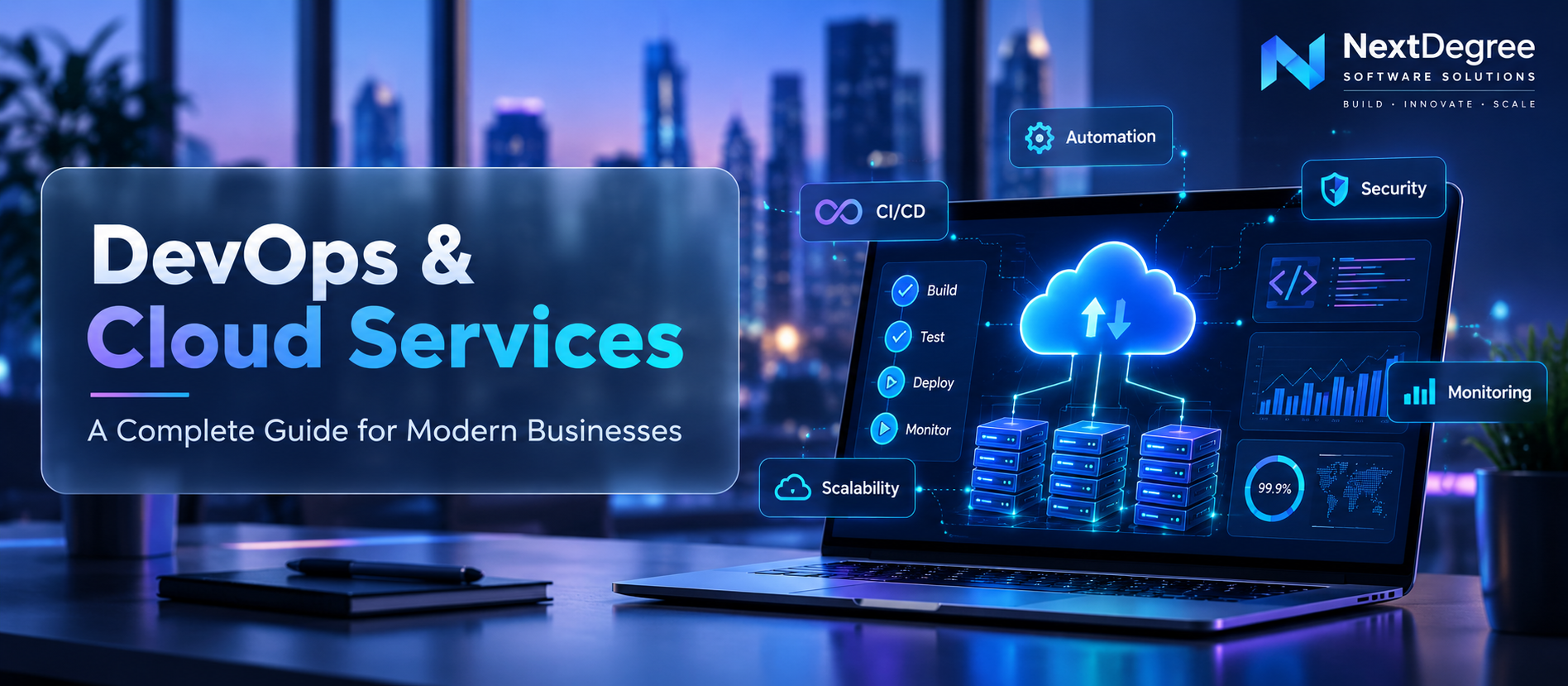
DevOps & Cloud Services: A Complete Guide for Modern Businesses
Modern businesses increasingly depend on software to manage operations, serve customers, analyze data, and support growth. As digital systems become more important, organizations also need reliable ways to develop, deploy, monitor, and scale their applications.
This is where DevOps & Cloud Services play a major role.
DevOps helps development and operations teams work together more efficiently, while cloud computing provides flexible infrastructure that can adapt to changing business needs. When combined, these approaches can improve software delivery, reduce operational risks, strengthen reliability, and support faster innovation.
For companies building digital products, modernizing legacy systems, or expanding their technology infrastructure, understanding DevOps and cloud services is essential.
This guide explains what DevOps and cloud services are, how they work together, their main benefits, the role of CI/CD automation, cloud infrastructure, security, scalability, and the key factors businesses should consider when choosing a DevOps and cloud services provider.
What Are DevOps & Cloud Services?
DevOps is an approach to software development and IT operations that promotes collaboration, automation, continuous improvement, and shared responsibility between development and operations teams.
Traditionally, developers focused on building software while operations teams were responsible for deploying and maintaining it. This separation could create delays, communication gaps, and inconsistent processes.
DevOps aims to reduce these barriers by creating a more integrated development lifecycle.
Cloud services, on the other hand, provide computing resources such as servers, databases, storage, networking, and software infrastructure over the internet.
Instead of purchasing and maintaining physical infrastructure, businesses can use cloud platforms such as Amazon Web Services, Microsoft Azure, or Google Cloud to access computing resources when needed.
When DevOps practices are combined with cloud infrastructure, organizations can automate software deployment, manage infrastructure more efficiently, and respond more quickly to changing requirements.
Why DevOps and Cloud Work Well Together
Cloud computing and DevOps are closely connected because both focus on flexibility, automation, and efficiency.
Cloud platforms allow infrastructure to be created, modified, and scaled programmatically. DevOps practices use this flexibility to automate many tasks that would otherwise require manual work.
For example, a development team can automatically test new software code, deploy it to a cloud environment, monitor its performance, and quickly release updates.
This creates a more consistent and repeatable software delivery process.
Cloud environments also support DevOps practices such as Infrastructure as Code, automated testing, monitoring, containerization, and continuous deployment.
As a result, businesses can create development environments faster and reduce the operational complexity associated with traditional infrastructure.
What Services Are Included in DevOps & Cloud Services?
A professional DevOps and cloud services provider may support businesses across several areas of infrastructure and software delivery.
Typical services may include:
- Cloud architecture and infrastructure design
- CI/CD pipeline implementation
- Infrastructure as Code
- Cloud migration
- Containerization and orchestration
- Application monitoring and logging
- Infrastructure automation
- Performance optimization
- Cloud security and access management
- Backup and disaster recovery
- DevOps consulting
- Cloud cost optimization
- Production support and maintenance
The exact services required depend on the organization's technology environment, applications, security needs, and business objectives.
What Is CI/CD Automation?
CI/CD is one of the most important concepts in modern DevOps.
CI stands for Continuous Integration, while CD can refer to Continuous Delivery or Continuous Deployment.
Continuous Integration allows developers to regularly merge code changes into a shared repository. Automated systems then test those changes to identify problems early.
Continuous Delivery prepares tested software changes so they can be released safely and efficiently.
Continuous Deployment takes automation further by automatically releasing approved changes into production.
A well-designed CI/CD pipeline can automate activities such as code compilation, testing, security checks, deployment, and monitoring.
This reduces manual work and helps development teams release software more consistently.
For businesses, CI/CD automation can support faster product improvements while reducing the risk of deployment errors.
The Importance of Cloud Infrastructure
Cloud infrastructure provides the technical foundation on which many modern applications operate.
Instead of depending entirely on physical servers located within an office or data center, organizations can use cloud environments to access infrastructure on demand.
This can include computing power, storage, databases, networking, analytics, and security services.
One of the main advantages of cloud infrastructure is flexibility.
Businesses can increase computing resources when demand grows and reduce them when demand decreases.
This is particularly valuable for digital platforms that experience changing traffic levels.
For example, an e-commerce platform may need significantly more infrastructure during seasonal campaigns than during normal periods.
A scalable cloud architecture allows the organization to respond to these changes more efficiently.
Infrastructure as Code
Infrastructure as Code, often abbreviated as IaC, is a DevOps practice that allows infrastructure to be defined and managed using configuration files or code.
Traditionally, infrastructure settings might be configured manually.
This approach can be slow and difficult to reproduce consistently.
With Infrastructure as Code, development teams can automate the creation and configuration of servers, networks, databases, and other infrastructure components.
Tools such as Terraform and cloud-native infrastructure services are commonly used for this purpose.
The main advantage is consistency.
The same infrastructure configuration can be deployed across development, testing, and production environments.
This can reduce configuration errors and make infrastructure management more transparent.
DevOps, Cloud, and Scalability
Scalability is an important requirement for modern digital products.
A software application may begin with a limited number of users but eventually need to support thousands or even millions.
Cloud infrastructure allows organizations to increase computing capacity as demand grows.
DevOps practices make this process more manageable through automation and monitoring.
For example, systems can be configured to automatically increase resources when traffic reaches a certain level.
This approach can help maintain application performance during periods of increased demand.
Scalable architecture also supports business growth without requiring organizations to completely rebuild their infrastructure every time usage increases.
Security in DevOps & Cloud Services
Security should be integrated throughout the software development lifecycle.
This approach is sometimes referred to as DevSecOps, which introduces security practices into DevOps workflows.
Instead of performing security checks only at the end of development, security can be included during coding, testing, deployment, and monitoring.
Important practices may include secure access controls, encryption, vulnerability scanning, secret management, network security, logging, and automated security testing.
Cloud platforms also provide tools for identity management, access permissions, monitoring, and threat detection.
However, cloud security still requires careful configuration and governance.
Organizations should define clear responsibilities and security policies when operating applications in cloud environments.
Benefits of DevOps & Cloud Services
One of the most important benefits of DevOps and cloud services is faster software delivery.
Automation can reduce the time required to test, deploy, and update applications.
Another benefit is greater consistency.
Automated processes help ensure that deployments follow the same steps each time, which can reduce human error.
DevOps can also improve collaboration between software developers, infrastructure teams, and other technical stakeholders.
Cloud infrastructure provides additional flexibility by allowing organizations to adjust resources according to actual requirements.
Businesses may also benefit from improved reliability because monitoring and automated recovery processes can identify problems more quickly.
When implemented correctly, DevOps and cloud services can create a technology environment that supports both operational stability and faster innovation.
DevOps & Cloud Services for Digital Transformation
Many digital transformation projects involve modernizing legacy applications and infrastructure.
Older systems may depend on manual deployment processes, physical servers, or outdated technologies that make change difficult.
Moving applications to modern cloud environments can create opportunities to improve scalability, security, and operational efficiency.
DevOps practices can support this transition by automating deployment and infrastructure management.
However, cloud migration should not simply involve moving an existing application from one server to another.
Organizations should first understand the architecture, dependencies, security requirements, and business objectives of the application.
In some cases, applications may need to be redesigned or modernized before they can fully benefit from cloud technologies.
Cloud Cost Optimization
Cloud infrastructure can provide significant flexibility, but poor configuration can also create unnecessary costs.
Businesses should therefore monitor resource usage and identify opportunities to improve efficiency.
Cloud cost optimization may involve removing unused resources, adjusting server sizes, selecting appropriate storage options, using automatic scaling, and monitoring spending patterns.
A DevOps team can help create visibility into cloud usage and automate some cost-control processes.
The objective should not simply be to minimize spending, but to achieve an appropriate balance between cost, performance, reliability, and scalability.
How to Choose a DevOps & Cloud Services Provider
Choosing the right technology partner can have a significant impact on the success of a DevOps or cloud initiative.
Businesses should evaluate whether the provider understands both software engineering and infrastructure operations.
Technical expertise should include areas such as cloud architecture, CI/CD automation, Infrastructure as Code, containers, security, monitoring, and system reliability.
It is also important to assess the provider's approach to communication and documentation.
DevOps infrastructure becomes an important part of a company's technology environment, so technical decisions should be transparent and well documented.
Businesses should also consider whether the provider offers long-term support.
Cloud environments require ongoing monitoring, optimization, updates, and security management.
A reliable partner should therefore be capable of supporting the environment after the initial implementation.
DevOps & Cloud Services and Business Growth
The value of DevOps and cloud services extends beyond the technical department.
Faster development cycles can allow businesses to introduce new features more quickly.
Improved infrastructure reliability can support a better customer experience.
Scalable cloud environments can help companies expand without making large upfront investments in physical infrastructure.
Automation can also reduce repetitive operational work and allow technical teams to focus on higher-value activities.
For growing businesses, these advantages can create a technology foundation that is more adaptable to future requirements.
Final Thoughts
DevOps & Cloud Services provide businesses with a modern approach to software delivery, infrastructure management, automation, and scalability.
By combining DevOps practices with cloud technologies, organizations can create more efficient development workflows, automate deployment processes, strengthen system reliability, and respond more effectively to changing business requirements.
However, successful implementation requires more than simply adopting new tools.
Businesses need a clear cloud strategy, appropriate architecture, automated processes, strong security practices, reliable monitoring, and continuous improvement.
Whether an organization is building a new application, migrating to the cloud, modernizing legacy systems, or improving software delivery, DevOps and cloud services can provide a strong technical foundation for sustainable digital growth.
The most effective approach begins by understanding the business objective and then designing the cloud infrastructure and DevOps processes required to support that objective over the long term.