Management Systems: How Digital Solutions Improve Business Efficiency and Decision-Making
As businesses grow, managing daily operations becomes increasingly complex. Information may be stored across spreadsheets, emails, messaging platforms, accounting tools, and separate departmental systems. While these tools may work individually, relying on disconnected processes can create delays, duplicated work, inconsistent data, and limited visibility across the organization.
This is where modern management systsems become essential.
A management system is a digital platform designed to organize, automate, monitor, and improve business processes. Depending on the organization, it may support areas such as finance, sales, human resources, inventory, projects, customer relationships, procurement, reporting, or internal approvals.
By bringing important processes and data into a structured digital environment, management systems can help businesses improve efficiency, reduce manual work, and make better-informed decisions.
What Are Management Systems?
Management systems are software solutions that help organizations control and coordinate their operations through centralized digital tools.
Rather than managing business activities through multiple disconnected files and applications, a management system can provide one structured platform for employees, managers, and decision-makers.
Common examples include:
[Enterprise Resource Planning systems](https://www.nextdegree.tech/services/erp-software-development) Customer Relationship Management systems Human Resources Management Systems Inventory management systems Project management systems Document management systems Financial management systems Workflow management systems Procurement management systems Performance management systems
Some companies use separate systems for each function, while others use integrated solutions that connect multiple departments within one platform.
The right structure depends on the size, industry, complexity, and operational requirements of the business.
How Digital Management Systems Improve Business Efficiency
1. Reducing Manual Work
One of the main benefits of digital management systems is automation.
Many organizations still rely heavily on manual processes such as data entry, approval emails, spreadsheet updates, and repetitive reporting.
These tasks require time and may increase the risk of human error.
A digital management system can automate processes such as:
Invoice generation Employee attendance tracking Purchase approvals Inventory updates Task assignments Customer follow-ups Report preparation Notifications and reminders
By reducing repetitive administrative work, employees can spend more time on activities that require judgment, communication, and strategic thinking.
2. Centralizing Business Information
Disconnected data can create serious operational problems.
For example, the sales department may have one version of customer data, while finance has another. Inventory records may also differ from actual stock levels.
Management systems help solve this problem by centralizing information.
When teams work from the same system, they can access more consistent and up-to-date data.
This can improve coordination between departments and reduce the need to repeatedly request or verify information.
A centralized system also makes it easier to create a single source of truth for business operations.
3. Improving Workflow Management
Business processes often involve several people or departments.
For example, a purchase request may need approval from a department manager, finance team, and procurement team before an order is placed.
Without a structured system, these requests may become delayed or lost in email threads.
A digital management system can create automated workflows.
Each request can move through predefined stages, with notifications sent to the appropriate employees.
The system can also record who approved each step and when it occurred.
This improves transparency, accountability, and process consistency.
The Role of Management Systems in Decision-Making
Good decisions depend on reliable information.
When data is incomplete, outdated, or stored across several systems, managers may struggle to understand what is actually happening inside the business.
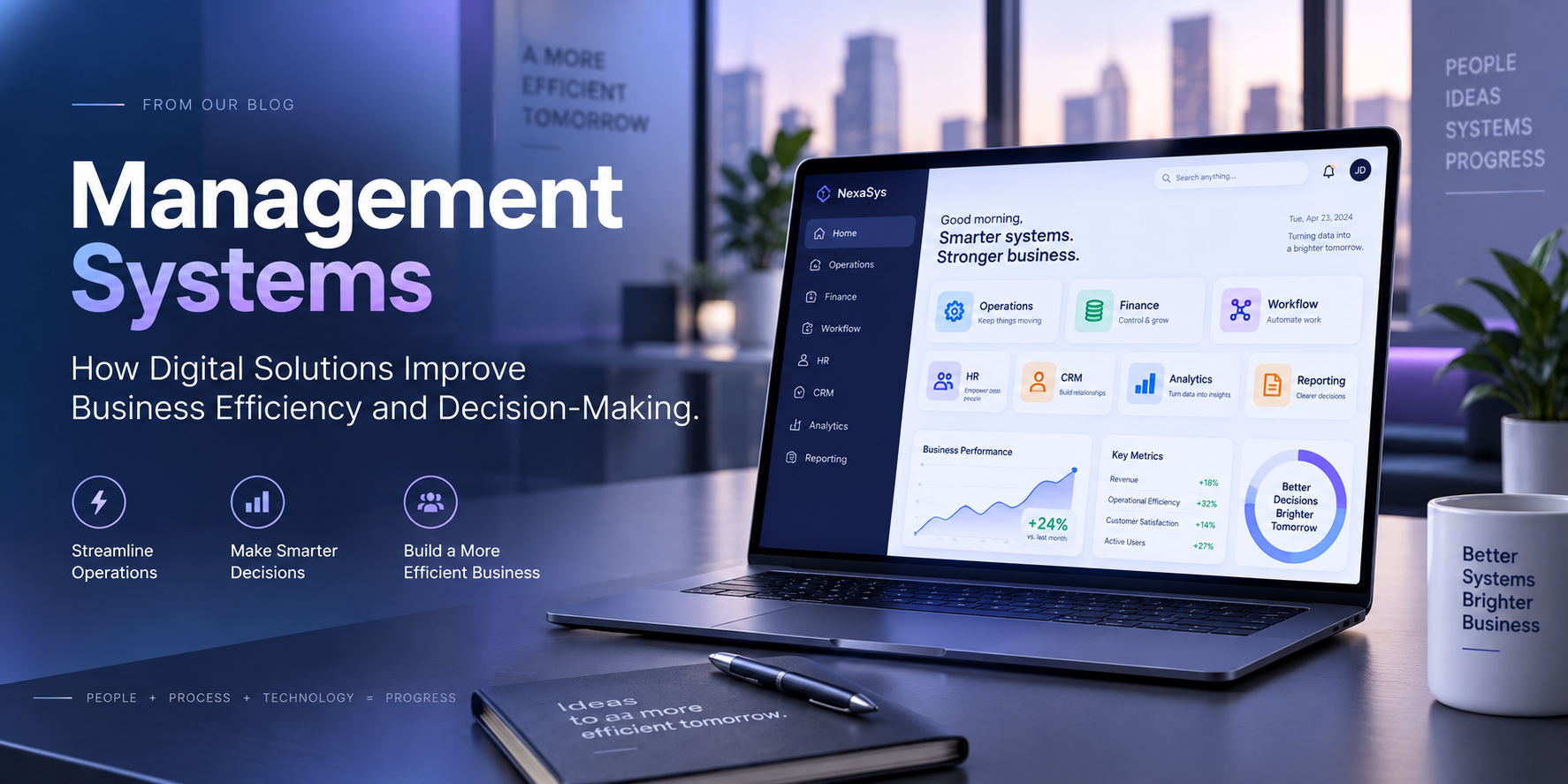
Digital management systems can provide dashboards and reports that convert operational data into useful information.
Management may monitor indicators such as:
Revenue Expenses Profitability Sales performance Inventory levels Employee productivity Project progress Customer activity Outstanding payments Operational costs
Instead of waiting for employees to manually prepare reports, decision-makers can access information more quickly.
This supports faster and more evidence-based decision-making.
Real-Time Visibility Across the Business
Real-time visibility is particularly valuable for growing organizations.
Managers need to understand current performance, not only what happened several weeks ago.
A digital management system can provide updated information about business operations.
For example, management may be able to see:
Current sales activity Stock availability Active projects Employee attendance Customer requests Pending approvals * Cash flow information
This visibility can help organizations respond more quickly to operational issues and identify opportunities before they are missed.
Improving Collaboration Between Departments
Departments often work toward different objectives, but their activities are connected.
Sales depends on inventory availability. Finance depends on accurate sales information. Human resources supports employees across all departments.
When each team uses separate tools, communication gaps may develop.
Integrated management systems improve collaboration by allowing departments to share information within the same digital environment.
For example, when a sales order is completed, the system may automatically update inventory and financial records.
This reduces the need for employees to manually transfer data between departments.
Better integration can also improve communication and reduce misunderstandings.
Essential Features of a Modern Management System
A strong management system should reflect the actual requirements of the organization.
However, several features are commonly valuable.
Centralized Dashboard
A dashboard provides a clear overview of important business information.
Different users may have different dashboards depending on their responsibilities.
Senior management may focus on performance indicators, while operational employees may see tasks, requests, and daily activities.
Workflow Automation
Workflow automation helps standardize recurring processes.
This can include approvals, notifications, task creation, document routing, and status updates.
Reporting and Analytics
Reporting tools help businesses understand performance and identify trends.
Custom reports can be designed around specific management requirements.
Role-Based Access
Not every employee should have access to all business information.
Role-based access allows organizations to control which data and features each user can view or modify.
System Integrations
Modern businesses use many digital tools.
A management system may need to connect with:
[ERP](https://www.nextdegree.tech/services/erp-software-development) CRM Accounting software Payment gateways E-commerce platforms Email systems Customer support platforms Business intelligence tools
These integrations help create a more connected digital environment.
Custom Management Systems vs. Ready-Made Solutions
Businesses can choose between ready-made software and custom management systems.
Ready-made solutions are often faster to implement and may be suitable for companies with standard requirements.
However, businesses may have to adapt their workflows to the software.
Custom management systems are designed around the organization’s actual processes.
This allows greater control over:
Features User roles Workflows Reports Integrations Interface design * Scalability
Custom solutions may require more planning and development, but they can be particularly valuable for organizations with specialized processes or long-term digital transformation goals.
Supporting Business Growth and Scalability
As businesses expand, operational complexity increases.
More employees, customers, products, branches, and transactions create additional management challenges.
A scalable management system can grow alongside the organization.
Businesses may begin with a small number of modules and later add new capabilities.
For example, a company may initially implement project and financial management, then add CRM, HR, procurement, or inventory management.
This approach allows organizations to develop their digital infrastructure gradually while maintaining consistency across the business.
Security and Data Control
Management systems often contain sensitive business information.
This may include financial records, customer information, employee data, contracts, and internal reports.
Security should therefore be a core consideration.
Important measures may include:
User authentication Role-based permissions Data encryption Regular backups Activity logs Secure integrations System monitoring Access controls
Businesses should also establish clear policies for data management, user access, and system updates.
How to Choose the Right Management System
Choosing the right solution should begin with understanding business needs.
Organizations should identify existing problems and determine which processes need improvement.
Key questions include:
Which processes are currently manual? Where is business data stored? Which departments need better integration? What reports does management need? Which tasks should be automated? What systems need to be connected? How many users will access the platform? How might business requirements change in the future?
The right management system should not simply add more technology. It should solve real operational problems and support long-term business objectives.
Conclusion
Management systems play an important role in modern business operations by helping organizations organize processes, centralize data, automate tasks, and improve decision-making.
Digital solutions can reduce manual work, improve collaboration, increase visibility, and provide managers with faster access to reliable information.
They can also support business growth by creating scalable processes that adapt as the organization expands.
However, successful implementation depends on choosing a system that reflects actual business needs.
Whether an organization chooses a ready-made platform or a custom management system, the goal should remain the same: to create a more connected, efficient, and data-driven business environment that supports better decisions and sustainable growth.