
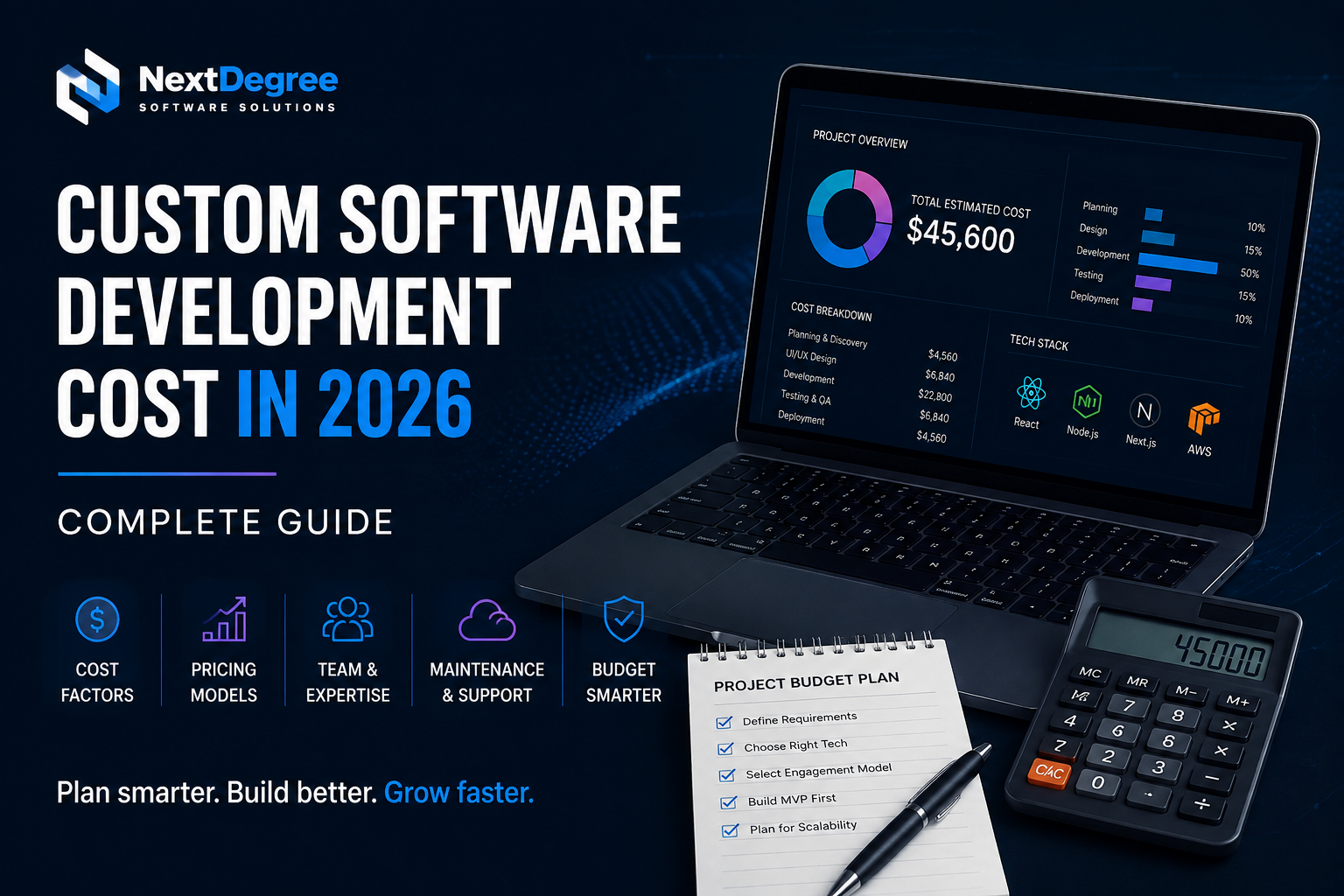
Custom Software Development Cost in 2026: Complete Guide
How much does custom software development cost in 2026?
The answer depends on what you are building. Project scope, software complexity, required features, integrations, platforms, security requirements, cloud infrastructure, engineering effort, and long-term maintenance all influence the final cost.
A focused Minimum Viable Product (MVP) generally requires less investment than an enterprise platform involving multiple applications, artificial intelligence, payment processing, complex integrations, or regulated financial functionality.
Instead of relying on a universal price, businesses should understand what drives custom software development cost, how professional development teams estimate projects, and how to control unnecessary expenses without sacrificing software quality.
This guide explains the major factors affecting custom software development pricing in 2026 and provides a practical framework for planning a realistic software budget.
If you are already planning a digital product, explore our Custom Software Development Services to understand how NextDegree approaches discovery, architecture, development, deployment, and continuous improvement.
---
How Much Does Custom Software Development Cost?
Custom software development cost depends primarily on project scope, complexity, functionality, integrations, development platforms, team composition, security requirements, infrastructure, and ongoing maintenance.
There is no meaningful universal price because custom software projects vary enormously.
A customer portal with authentication and basic reporting is fundamentally different from an enterprise platform involving artificial intelligence, mobile applications, payment processing, multiple databases, external APIs, and high-availability infrastructure.
For this reason, a professional software development company normally evaluates requirements before producing an accurate estimate.
Instead of asking only:
“How much does software cost?”
A more useful question is:
“What engineering effort is required to design, build, test, deploy, secure, operate, and maintain the software our business actually needs?”
That distinction leads to significantly more reliable budgeting.
---
What Affects Custom Software Development Cost?
Several factors have a direct impact on custom software development pricing.
1. Project Scope
Project scope is one of the strongest cost drivers.
A small internal application with authentication, a dashboard, and basic reporting requires less engineering than a platform containing:
Multiple user roles Web and mobile applications Payment processing Advanced analytics Real-time notifications Third-party integrations Artificial intelligence Complex administration dashboards Cloud infrastructure Advanced security controls
Clear requirements reduce uncertainty and make development estimates more accurate.
---
2. Software Complexity
Two applications can have a similar number of screens but dramatically different engineering requirements.
Consider a basic appointment-booking application and a fintech platform processing financial transactions.
Both may contain user accounts, dashboards, notifications, and administrative functionality.
However, the fintech platform may additionally require:
Strong authentication Transaction integrity Audit logging Encryption Payment integrations Financial reconciliation Fraud controls High availability * Regulatory considerations
Therefore, software complexity matters considerably more than simply counting pages or screens.
For businesses developing payment-oriented products, our Payment & Wallet Platform Services provide additional information about digital wallets, payment systems, integrations, and fintech architecture.
---
Typical Custom Software Project Complexity
A useful way to estimate initial project size is to classify the software according to its complexity.
Focused MVP — Low to Medium Complexity
Examples include:
Customer portals Internal business tools Basic marketplaces Proof-of-concept platforms * Simple workflow applications
A focused MVP concentrates on the essential functionality needed to validate a business idea or operational requirement.
Business Application — Medium Complexity
Examples include:
CRM systems Workflow platforms Business dashboards Mobile applications * Customer-management systems
These systems usually contain more business rules, integrations, permissions, and reporting requirements.
Advanced Platform — Medium to High Complexity
Examples include:
SaaS platforms Multi-role marketplaces AI-enabled applications Subscription platforms * Large customer-facing applications
These projects often require scalable architecture, sophisticated user management, external integrations, and more extensive testing.
Enterprise System — High Complexity
Examples include:
ERP systems Multi-system integrations Large business platforms Enterprise workflow automation * Legacy-system modernization
Enterprise software typically requires substantial architecture, security, integration, migration, and operational planning.
Fintech Platform — High Complexity
Examples include:
Digital wallets Payment platforms Transaction systems Financial applications * Banking integrations
Financial software typically has additional security, reliability, auditability, integration, and compliance requirements.
These categories are more useful than fixed-price promises because two applications that appear similar to users can have completely different backend, integration, security, and scalability requirements.
---
How Features Affect Custom Software Development Price
Every feature requires some combination of requirements analysis, UX design, architecture, development, testing, deployment, and maintenance.
Authentication and User Management
Basic authentication may be relatively straightforward.
Costs increase when the software requires:
Multi-factor authentication Single sign-on Enterprise identity providers Role-based access control Complex permissions Audit trails * Advanced account security
These requirements become particularly important in enterprise and financial applications.
---
Dashboards and Reporting
Simple dashboards may use standard charts and reports.
More sophisticated applications may require:
Real-time analytics Large datasets Custom reports Business intelligence Forecasting Data aggregation Role-specific dashboards Export and reporting functionality
The underlying data architecture can significantly influence development effort.
---
Payment Processing
Payment functionality introduces additional engineering considerations.
These may include:
Payment gateway integration Digital wallets Subscriptions Refund processing Transaction reconciliation Multi-currency support Financial reporting Transaction notifications * Payment security
Payment platforms also require greater attention to security, availability, reliability, and monitoring.
---
Third-Party Integrations
Modern business applications rarely operate in isolation.
Custom software may need to integrate with:
CRM platforms ERP systems Payment gateways Accounting software Logistics platforms Email services SMS services Identity providers Existing databases Cloud platforms * External APIs
The quality, documentation, limitations, and complexity of external systems can substantially affect development time.
---
How Much Does an MVP Cost?
An MVP, or Minimum Viable Product, focuses on the smallest set of functionality required to validate a product or business concept.
An MVP can reduce initial custom software development cost because non-essential features are postponed until the core product has been tested with real users.
A strong MVP normally focuses on:
- The primary customer or business problem
- Essential user journeys
- Core product functionality
- Essential integrations
- Basic analytics and monitoring
- Appropriate production architecture
The objective of an MVP is not to build low-quality software cheaply.
The objective is to avoid spending significant resources developing functionality before the business has established that users actually need it.
Once the core product is validated, additional features can be prioritized using real usage data and customer feedback.
---
Web Application vs Mobile App Development Cost
Platform selection also affects software development cost.
Web Applications
A responsive web application can be an efficient option when browser access, centralized deployment, and broad device compatibility are priorities.
One application can serve users across desktop computers, tablets, and mobile browsers.
Native Mobile Applications
Native iOS and Android development can be appropriate when a product requires:
Deep operating-system integration Platform-specific functionality Advanced device capabilities Maximum native performance
Supporting multiple native platforms can increase engineering and maintenance requirements.
Cross-Platform Mobile Applications
Cross-platform technologies can reduce duplicated development effort when a shared codebase provides sufficient performance and access to required device functionality.
Technology selection should nevertheless be driven by product requirements rather than cost alone.
If mobile applications are central to your product strategy, explore NextDegree's Mobile App Development Services.
---
How AI Affects Custom Software Development Cost
Artificial intelligence can significantly increase both the capabilities and engineering complexity of custom software.
AI functionality can include:
AI assistants AI agents Recommendation engines Document processing Natural language processing Predictive analytics Computer vision Intelligent search Workflow automation Generative AI
However, the cost of an AI application does not come only from the AI model itself.
A production AI system may also require:
Data preparation Model or API integration Application development Evaluation Security controls Monitoring Cloud infrastructure Usage management Human review workflows Ongoing optimization
Businesses should therefore evaluate AI according to measurable business value rather than adding AI simply because the technology is popular.
Learn more about how these capabilities can be integrated into business applications through our AI Development Services.
---
How Much Does Bespoke Software Cost?
Bespoke software development cost depends on requirements, complexity, engineering effort, integrations, security, infrastructure, and ongoing support.
“Bespoke software” and “custom software” generally describe the same fundamental concept: software designed around the specific requirements of an organization rather than a standardized product designed for many customers.
The term bespoke software is particularly common in the UK and some international markets, while custom software is widely used globally.
In either case, accurate pricing requires an understanding of what needs to be designed, developed, integrated, deployed, and maintained.
---
Custom Software vs Off-the-Shelf Software
Off-the-shelf software is usually less expensive to adopt initially because development costs are distributed across many customers.
Custom software typically requires a greater initial investment but provides considerably more control over functionality, integrations, architecture, and business workflows.
Custom Software
Custom software can provide:
Business-specific functionality Greater customization Flexible integrations Architecture designed around specific requirements Greater control over future development Potential competitive differentiation
Off-the-Shelf Software
Off-the-shelf products can provide:
Lower initial implementation costs Faster initial deployment Existing features Vendor-managed product development
However, businesses may need to adapt their workflows to the limitations of the product.
Custom development is most valuable when software contributes directly to revenue, operational efficiency, automation, customer experience, or competitive advantage.
Read our Custom Software vs Off-the-Shelf Software: Which Is Right for Your Business? for a more detailed comparison.
---
Fixed Price vs Hourly Development Rates
Another factor affecting custom software development pricing is the commercial engagement model.
Fixed-Price Development
A fixed-price model works best when requirements, deliverables, and acceptance criteria are clearly defined.
Its primary advantage is budget predictability.
However, significant changes to the agreed scope may require additional estimates.
Time and Materials
With a time-and-materials model, the client pays according to engineering effort.
This provides greater flexibility when requirements are expected to evolve and can be appropriate for complex or iterative products.
Dedicated Development Team
A dedicated engineering team works continuously on a product or portfolio.
This model can be suitable for organizations that require ongoing software development capacity and continuous product evolution.
The best engagement model depends on project maturity, requirements stability, timeline, and business objectives.
---
Development Team Composition
Professional custom software is rarely produced by developers alone.
Depending on the project, the engineering team may include:
Business analyst UI/UX designer Frontend engineer Backend engineer Mobile developer AI/ML engineer QA engineer DevOps/cloud engineer Cybersecurity specialist Solution architect Project manager Product manager
More complex systems require broader expertise.
Removing essential roles simply to reduce an initial quotation can increase long-term costs through technical debt, poor usability, security problems, operational issues, and expensive redevelopment.
---
Cloud Infrastructure and DevOps Costs
Software development cost does not end when the source code is complete.
Production applications require infrastructure.
Depending on the system, this may include:
Cloud hosting Databases Object storage Content delivery networks Backups Monitoring Logging CI/CD pipelines Containers Disaster recovery * Security services
Infrastructure costs depend on architecture, traffic, storage, availability requirements, and workload characteristics.
The AWS Well-Architected Framework identifies cost optimization, security, reliability, operational excellence, performance efficiency, and sustainability as important architectural considerations.
The Google Cloud Well-Architected Framework similarly provides guidance for designing secure, reliable, cost-effective, and operationally efficient cloud workloads.
For implementation and infrastructure engineering, explore NextDegree's DevOps & Cloud Services.
---
Security Requirements and Development Cost
Security should be incorporated into software architecture from the beginning rather than added immediately before launch.
Depending on the application, security requirements can include:
Encryption Secure authentication Authorization controls Audit logging Secure API design Vulnerability management Backup and recovery Security monitoring Data protection Regulatory requirements
Fintech, healthcare, enterprise, and other applications processing sensitive information often require greater security engineering than ordinary applications.
These requirements affect development effort but should not be treated as optional extras.
The OWASP Top 10 is a widely used awareness resource for important web application security risks.
---
Custom Software Maintenance Cost
One commonly overlooked expense is custom software support cost after launch.
Production software requires ongoing maintenance.
Typical activities include:
Bug fixes Security updates Dependency updates Infrastructure maintenance Performance optimization Monitoring Backups Platform compatibility updates New features Third-party API updates
Businesses should therefore evaluate both the initial custom software development cost and the long-term total cost of ownership.
A lower initial development quotation does not necessarily mean a lower long-term software cost.
---
Hidden Costs Businesses Should Consider
Some expenses are frequently missed during early software planning.
Cloud Infrastructure
Hosting, databases, storage, bandwidth, monitoring, and backups can create recurring costs.
Third-Party APIs
Payment gateways, mapping services, communication platforms, AI APIs, and other external services may charge according to usage.
Software Licensing
Some commercial libraries, platforms, and software components require licenses.
Mobile Distribution
Mobile products may require developer accounts and app-store-related expenses.
Maintenance
Security updates, dependency upgrades, bug fixes, and compatibility work continue after launch.
Scaling
Infrastructure requirements can increase as users, transactions, and stored data grow.
Training
Internal enterprise systems may require employee onboarding and training.
Data Migration
Moving, cleaning, transforming, and validating legacy data can become a substantial engineering project.
These costs should be identified during requirements discovery rather than after development begins.
---
How to Reduce Custom Software Development Cost
Reducing development cost should mean eliminating unnecessary engineering effort, not sacrificing essential quality.
Start With Clear Requirements
Poorly defined requirements create uncertainty and rework.
Requirements discovery can therefore reduce overall development cost by identifying problems before expensive implementation begins.
Build an MVP First
Prioritize the functionality required to validate the business case.
Secondary features can be added after receiving real customer and operational feedback.
Reuse Proven Technology
Not every capability needs to be developed from scratch.
Established frameworks, libraries, APIs, and managed cloud services can reduce development effort when they are appropriate for the project.
Prioritize Integrations
Separate integrations required for the initial release from functionality that can be introduced later.
Automate Testing and Deployment
Automated testing and CI/CD pipelines can reduce repetitive engineering work and deployment risk.
Design for Appropriate Scale
Do not engineer infrastructure for millions of users if the product initially needs to support thousands.
Architecture should accommodate realistic future growth without introducing unnecessary early complexity.
---
How to Estimate a Custom Software Project
A professional estimate normally begins with discovery.
Before requesting a software quotation, answer these questions.
1. What business problem must the software solve?
Clearly define the business objective.
2. Who will use the software?
Identify customers, employees, administrators, partners, or other user groups.
3. What functionality is essential?
Separate essential requirements from optional features.
4. Which integrations are required?
Identify payment systems, APIs, databases, ERP/CRM platforms, and other external services.
5. What information will the system process?
Sensitive or regulated information may introduce additional security requirements.
6. What scale is expected?
Estimate users, transactions, data volumes, and traffic.
7. Which platforms are required?
Determine whether the project requires web, Android, iOS, desktop, or multiple platforms.
8. What infrastructure is required?
Consider hosting, availability, backups, monitoring, and disaster recovery.
9. Is there a required launch date?
Timeline constraints can affect team structure and project planning.
Once these questions are understood, engineering effort can be estimated considerably more accurately.
---
Frequently Asked Questions About Custom Software Development Cost
How much does custom software development cost?
Custom software development cost varies according to project scope, complexity, integrations, security, platforms, infrastructure, and required engineering effort. A focused MVP generally requires less investment than an enterprise, AI-enabled, or fintech platform. Requirements discovery is the most reliable way to produce an accurate estimate.
What is the average cost of custom software development?
There is no meaningful universal average because custom applications range from small internal tools to large enterprise platforms. Businesses should compare estimates according to scope, engineering effort, team composition, infrastructure, and total cost of ownership rather than relying on one global average.
What affects custom software development pricing?
The major pricing factors include project scope, complexity, functionality, integrations, development platforms, engineering team composition, security requirements, testing, infrastructure, deployment, and long-term maintenance.
Why is custom software expensive?
Custom software requires dedicated analysis, architecture, product design, engineering, testing, security, deployment, and maintenance around the requirements of a specific organization. Unlike standardized products, these engineering costs are concentrated around one business solution.
Is custom software worth the cost?
Custom software can justify its investment when it meaningfully improves revenue, automation, operational efficiency, customer experience, or competitive differentiation. The business case should be evaluated before development begins.
How long does custom software development take?
Development time depends on scope and complexity. A focused MVP can generally be completed significantly faster than an enterprise platform involving multiple applications, complex integrations, artificial intelligence, payment systems, or extensive security requirements.
How much does bespoke software cost?
Bespoke software cost depends on the same factors as custom software development: requirements, complexity, engineering effort, integrations, infrastructure, security, and ongoing support.
How can a business reduce custom software development costs?
Businesses can control development costs by clearly defining requirements, prioritizing essential functionality, starting with an MVP where appropriate, using proven technologies, avoiding unnecessary complexity, and automating testing and deployment.
Does custom software development cost include maintenance?
Not necessarily. Businesses should confirm whether a proposal includes post-launch support, cloud infrastructure, monitoring, backups, security updates, dependency upgrades, bug fixes, and ongoing maintenance.
---
How to Choose a Custom Software Development Company
Price should not be the only criterion when selecting a development partner.
Businesses should evaluate whether a software company can:
Understand the business problem Translate requirements into a technical solution Design maintainable architecture Implement appropriate security Integrate with existing systems Test software systematically Deploy and monitor production systems Communicate clearly throughout development * Provide post-launch support
A low initial quotation can become significantly more expensive if the resulting application requires major redevelopment.
For a detailed evaluation framework, read our How to Choose a Custom Software Development Company in 2026.
---
Planning a Custom Software Project?
A reliable custom software estimate begins with understanding requirements rather than selecting an arbitrary development package.
NextDegree designs and develops digital products across custom software, web applications, mobile applications, AI solutions, fintech systems, SaaS platforms, and cloud infrastructure.
If you are evaluating a new digital product, replacing legacy software, developing an MVP, or scaling an existing platform, start by defining the business problem, required functionality, integrations, security requirements, and expected scale.