
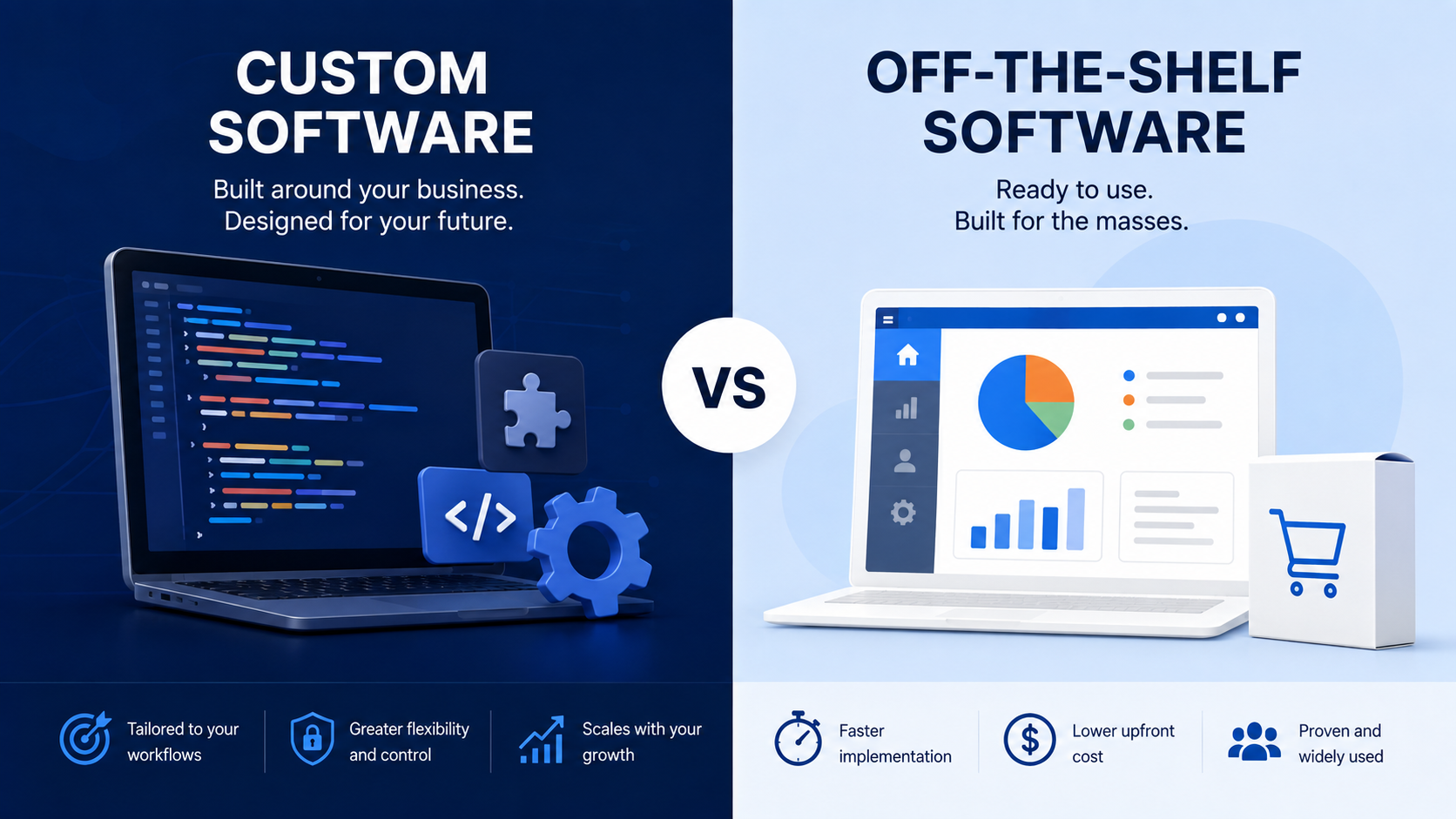
Choosing between custom software and off-the-shelf software is a strategic business decision, not simply a technical one. The right option depends on how closely an existing product fits your workflows, integrations, security requirements, growth plans, budget, and long-term digital strategy.
Off-the-shelf software is usually faster to implement and can be highly effective when business requirements are standardized. Custom software becomes more attractive when existing products create operational workarounds, integration limitations, restricted user experiences, or dependencies that prevent the business from evolving efficiently.
The right question is therefore not simply “Should we build or buy software?” It is:
Which approach gives the business the right balance of speed, cost, control, scalability, and long-term flexibility?
Key Takeaways
- Off-the-shelf software is often the better choice when requirements are common, implementation speed is important, and an existing platform already solves the problem effectively.
- Custom software becomes more valuable when your business relies on unique workflows, specialized integrations, automation, differentiated customer experiences, or proprietary business logic.
- Initial price alone is not enough. Businesses should evaluate total cost of ownership, including licensing, integrations, customization, maintenance, migration, infrastructure, and future development.
- Neither custom nor packaged software is automatically more secure or scalable. Architecture, implementation, governance, and operations matter more.
- Many organizations benefit from a hybrid approach that combines reliable third-party platforms with custom-built capabilities where differentiation matters.
What Is Custom Software?
Custom software, sometimes called bespoke software, is designed and developed specifically around the needs of a particular organization.
Instead of requiring the business to adapt its processes to predefined software, a custom application can be designed around existing workflows, users, data structures, integrations, security requirements, and strategic objectives.
Examples may include customer portals, supplier platforms, custom CRM systems, fintech applications, payment platforms, enterprise dashboards, workflow automation solutions, mobile applications, or systems that integrate multiple existing platforms.
The primary advantage of custom software is control and flexibility.
The organization can influence how the product works, which capabilities are prioritized, how different systems integrate, how data is structured, and how the platform evolves.
However, greater control also brings greater responsibility. Custom applications need proper product management, architecture, development, testing, security, deployment, monitoring, documentation, and long-term maintenance.
If your requirements already indicate that a bespoke solution may be necessary, explore NextDegree Custom Software Development Services.
What Is Off-the-Shelf Software?
Off-the-shelf software is a prebuilt product designed to serve many organizations with similar requirements.
Examples include accounting platforms, CRM systems, project management tools, HR systems, collaboration applications, help-desk platforms, e-commerce solutions, and marketing software.
Because the application already exists, implementation can often begin much faster than with a custom development project.
This makes commercial software especially attractive when the business requirement is standardized and mature products already solve the problem well.
For example, building an entirely new accounting platform for a company that only needs standard accounting functions would rarely make strategic sense. An established product may already provide the functionality, reporting, updates, security controls, integrations, and support the organization needs.
The important principle is:
Do not build custom software merely because custom development is technically possible. Build when customization creates meaningful operational or strategic value.
Custom Software vs Off-the-Shelf Software Comparison
| Factor | Custom Software | Off-the-Shelf Software | |---|---|---| | Implementation speed | Usually slower initially | Usually faster | | Initial investment | Typically higher | Usually lower initially | | Business-process fit | Designed around specific workflows | Business often adapts to the product | | Customization | High | Limited by vendor capabilities | | Integrations | Can be engineered around requirements | Depends on APIs and available connectors | | User experience | Can be tailored to specific users | Usually standardized | | Data model | Can follow business requirements | Primarily defined by vendor | | Product roadmap | Driven by your priorities | Driven by vendor priorities | | Scalability | Can be designed around expected growth | Depends on product architecture and plans | | Maintenance | Managed internally or by a technology partner | Primarily vendor-managed | | Vendor dependency | Can be reduced with appropriate architecture | Often higher | | Long-term flexibility | Potentially very high | Depends on the vendor ecosystem |
Neither approach wins every category.
A company should evaluate which factors have the greatest business impact rather than choosing based on one criterion such as initial cost or implementation speed.
When Is Off-the-Shelf Software the Better Choice?
Commercial software is often the right solution when the business problem is already well understood and standardized.
An existing platform can be particularly effective when your requirements fit its operating model without extensive customization or manual workarounds.
For example, a business may need project management, payroll, accounting, email marketing, customer support, or standard CRM functionality. Mature commercial platforms already address these needs effectively for many organizations.
Buying instead of building can also reduce the amount of infrastructure, maintenance, and product development the organization must manage internally.
The strongest case for off-the-shelf software exists when the platform provides a good functional fit, integrates with your existing technology environment, has acceptable licensing economics, and does not restrict strategically important business processes.
When Does Custom Software Become the Better Choice?
Custom development becomes more compelling when the limitations of existing products begin affecting the business itself.
Imagine an organization that requires specialized approval workflows, dynamic pricing logic, complex integrations, customer and supplier portals, multiple permission models, proprietary analytics, workflow automation, or connectivity with legacy applications.
A packaged product might support some of these requirements.
But if teams repeatedly compensate for missing functionality using spreadsheets, email approvals, duplicated data entry, disconnected applications, manual reconciliation, or fragile scripts, the organization may be paying an increasing operational cost for software that does not fit.
At that stage, the real comparison is no longer:
“A software subscription versus a custom development project.”
It becomes:
“The long-term cost and limitations of our current operating model versus the value of creating a platform designed around the business.”
1. Business Process Fit
Business fit should be one of the first criteria in a build-versus-buy decision.
A commercial product may meet most of your requirements, and that can be completely acceptable if the missing capabilities are not strategically important.
The problem begins when the unsupported processes are exactly the ones that differentiate the organization.
Suppose, for example, that a company has a specialized workflow involving sales, finance, operations, suppliers, and management approvals.
If a packaged platform cannot model this workflow effectively, employees may move parts of the process outside the system.
Over time, these workarounds can reduce visibility, make reporting more difficult, introduce duplicate data, and create operational dependencies on manual tasks.
Custom software allows the technology to follow the required business process rather than forcing the process to follow the limitations of the product.
2. Total Cost of Ownership
One of the biggest mistakes when comparing custom software vs off-the-shelf software is comparing only their initial prices.
The more useful metric is total cost of ownership, or TCO.
Commercial software costs can include subscription fees, per-user licensing, premium modules, implementation services, custom configuration, integrations, data migration, training, support plans, and future pricing changes.
Custom software costs can include discovery, UX design, architecture, software engineering, testing, security, infrastructure, monitoring, support, maintenance, and continued product development.
A packaged platform can therefore have a lower initial cost without necessarily producing the lowest long-term cost.
The opposite is also true: a custom application should not be justified using the assumption that it will automatically become cheaper over time.
The correct decision depends on user numbers, business complexity, licensing economics, development scope, integration requirements, expected lifetime, infrastructure, and ongoing maintenance.
For a deeper analysis, read Custom Software Development Cost in 2026: Complete Guide.
3. Implementation Speed
Off-the-shelf products usually have an important advantage when rapid implementation is the main priority.
Because the application already exists, organizations may only need configuration, integrations, user setup, data migration, training, and rollout.
Custom software requires additional stages such as discovery, requirements analysis, UX design, system architecture, development, quality assurance, security testing, deployment, and operational preparation.
However, implementation speed should not be evaluated in isolation.
A system that launches quickly but requires extensive manual workarounds may not produce business value as quickly as expected.
A better comparison is:
Time to deployment + time to achieve the required business capability.
Those two measurements are not always the same.
4. Integration Requirements
Integration complexity can significantly change the build-versus-buy decision.
Modern organizations rarely operate one isolated application.
Business systems frequently need to exchange data with ERP platforms, CRM systems, payment providers, logistics services, identity providers, analytics tools, mobile applications, government services, or internal APIs.
Commercial software can work extremely well when the required integrations already exist and the vendor provides reliable APIs.
Challenges arise when APIs expose limited functionality, integration volumes are restricted, synchronization requirements are complex, or key business workflows cannot be implemented using the vendor's integration model.
With custom software, integration can become part of the platform architecture itself.
Depending on the requirement, engineering teams may use APIs, webhooks, messaging systems, asynchronous processing, event-driven architecture, identity federation, or dedicated integration services.
The important question is therefore not simply:
“Does this platform provide an API?”
It is:
“Can the platform reliably support the integration flows required by our business?”
5. Data Ownership and Portability
Data ownership should be evaluated before selecting any major software platform.
Important questions include how information can be exported, which formats are available, how backups are handled, where data is hosted, what API access is provided, what happens when the contract ends, and how difficult migration to another system would be.
Custom software can provide greater control over databases, infrastructure, and application data models.
However, ownership still needs to be clearly defined through technical documentation, contracts, source-code arrangements, and infrastructure access.
A commercial platform may also provide strong data portability, but businesses should verify this rather than assume it.
A good technology decision should always include an exit strategy, even when there are no immediate plans to change platforms.
6. Vendor Lock-In
Vendor dependency is not automatically a bad thing.
Organizations intentionally depend on cloud providers, payment processors, CRM vendors, and many other technology partners because the benefits can significantly exceed the disadvantages.
The real risk is dependency that is not understood.
Over time, a company may become dependent on proprietary workflows, data structures, integrations, plugins, APIs, or extensions that make migration difficult.
Custom development can reduce some types of vendor lock-in, but poorly engineered custom software can create another problem: dependency on a single developer or company that is the only party capable of maintaining the application.
Good software engineering should reduce this risk through documentation, version control, maintainable architecture, standard technologies, automated deployment, testing, and appropriate knowledge transfer.
The objective is not to eliminate all dependencies.
The objective is to understand and manage them.
7. Security
Neither custom software nor off-the-shelf software is automatically more secure.
Large SaaS vendors may operate experienced security teams, mature monitoring systems, established vulnerability-management processes, and substantial security infrastructure.
Custom software can provide greater control over architecture, authentication, permissions, infrastructure, data flows, and security policies.
But that control only becomes an advantage when the application is engineered and operated securely.
Security considerations should include authentication, authorization, encryption, secrets management, secure APIs, dependency management, vulnerability handling, logging, monitoring, backups, recovery, and incident response.
Security should also be incorporated throughout development rather than added shortly before deployment.
The NIST Secure Software Development Framework provides a useful reference for integrating secure software development practices into the software lifecycle.
The right question is therefore not:
“Is custom software more secure?”
It is:
“Does this specific solution have an appropriate security architecture, development process, and operating model for our risk profile?”
8. Scalability
Scalability is especially important for organizations expecting significant growth.
It involves much more than supporting additional website visitors.
A business platform may eventually need to support additional users, transactions, products, locations, integrations, countries, business units, workflows, and data volumes.
Commercial platforms may provide excellent technical scalability, especially when delivered as mature cloud services.
However, organizations can still face functional or commercial constraints as they grow.
For example, additional functionality may require higher pricing tiers, specific integrations may remain unavailable, or business processes may exceed what the platform was designed to support.
Custom software can be engineered around expected growth patterns, but custom software does not automatically scale just because it is bespoke.
Scalability requires deliberate decisions around databases, APIs, caching, asynchronous workloads, cloud infrastructure, monitoring, observability, deployment, and resilience.
9. Maintenance and Product Roadmap
One major advantage of commercial software is that the vendor manages the core product.
Software updates, infrastructure, feature development, and many security improvements are handled centrally.
The trade-off is reduced control over the roadmap.
A feature that is business-critical for your company may not be a priority for the vendor.
Custom software provides much greater control over product priorities.
New functionality, integrations, automation, reporting, and user experiences can be developed based on your organization's strategy.
However, this flexibility creates responsibility for technical debt, security updates, infrastructure, monitoring, testing, support, and continued engineering.
For this reason, custom software should be considered a long-term digital product, not simply a one-time software project.
A Practical Build-vs-Buy Decision Framework
Before making the decision, evaluate the following areas:
| Decision Area | Question to Ask | |---|---| | Business processes | Are our most important workflows standard or unique? | | Functional fit | Can an existing platform meet the critical requirements? | | Integrations | Which internal and external systems must connect? | | Cost | What is the realistic multi-year total cost of ownership? | | Data | How important are ownership, portability, and migration? | | Security | Do we have specialized security or governance requirements? | | Scalability | What growth scenarios must the solution support? | | User experience | Does the customer or employee experience need to be differentiated? | | Vendor dependency | How difficult would it be to change providers? | | Product roadmap | How frequently do our requirements evolve? | | Maintenance | Who will operate and support the solution? | | Strategic value | Does this software directly create competitive differentiation? |
The objective of this framework is not to produce an automatic mathematical answer.
Its purpose is to identify which trade-offs matter most to your organization.
A Hybrid Strategy May Be the Best Option
The choice does not always need to be entirely custom or entirely off-the-shelf.
Many effective software architectures combine both.
A company might use an established cloud provider, commercial identity platform, third-party payment gateway, email provider, analytics platform, and CRM while developing a custom application for the workflows that differentiate its business.
This strategy avoids rebuilding mature commodity capabilities while preserving flexibility where customization genuinely adds value.
The architectural question therefore becomes:
What should we build, what should we buy, and how should these components integrate?
For many organizations, this creates a stronger balance between implementation speed, engineering control, cost, and long-term flexibility.
When Should You Choose Off-the-Shelf Software?
Choose off-the-shelf software when your requirements are standardized, an established product already provides a strong functional fit, implementation speed is important, customization requirements are limited, integrations are available, and the software itself is not a major source of competitive differentiation.
In those circumstances, building an entirely new system can introduce unnecessary cost and operational responsibility.
When Should You Choose Custom Software?
Custom development becomes more appropriate when the organization relies on unique workflows, complex integrations, specialized user experiences, proprietary business logic, advanced automation, stronger data control, or a technology roadmap that cannot depend entirely on a third-party vendor.
It is also worth evaluating when existing applications create increasing numbers of manual processes and technical workarounds.
If your company has already decided that custom development is likely to be required, the next decision is selecting the right technology partner. Read How to Choose a Custom Software Development Company in 2026.
Frequently Asked Questions
Is custom software better than off-the-shelf software?
Not automatically. Custom software is most valuable when an organization has workflows, integrations, automation, data requirements, or product capabilities that existing software cannot support efficiently. Off-the-shelf software may be the better option when requirements are standardized and a mature product already provides a strong fit.
Is custom software more expensive?
Custom development normally requires a higher initial engineering investment because the application must be designed, built, tested, deployed, and maintained. However, organizations should evaluate total cost of ownership rather than initial development cost alone.
What is the main disadvantage of off-the-shelf software?
The primary limitation is usually flexibility. Businesses operate within the workflows, integrations, customization options, licensing model, and product roadmap provided by the vendor.
What is the biggest risk of custom software?
Common risks include unclear requirements, uncontrolled scope, poor architecture, inadequate testing, security weaknesses, technical debt, insufficient documentation, and lack of long-term product ownership.
Can off-the-shelf software be customized?
Yes. Many platforms support configuration, APIs, plugins, extensions, workflow tools, and third-party integrations. The question is whether the required level of customization remains maintainable and cost-effective as the business evolves.
When should a company replace packaged software with a custom system?
Custom development should be evaluated when existing software creates significant manual workarounds, prevents important integrations, restricts new products, creates problematic licensing economics, or fails to support strategically important business processes.
Can custom software integrate with an existing ERP or CRM?
Yes. A custom application can complement ERP, CRM, payment, identity, logistics, analytics, and other systems rather than replacing them. The feasibility depends on the APIs, integration capabilities, security requirements, and architecture of the systems involved.
Should startups build custom software?
Startups should generally invest in custom development where technology creates real product or competitive differentiation. Standard capabilities that mature third-party services already provide can often be purchased or integrated instead of rebuilt.
Custom Software vs Off-the-Shelf Software: Final Decision
There is no universal winner in the custom software vs off-the-shelf software comparison.
Off-the-shelf software is often the right choice when requirements are standardized, implementation speed matters, integrations are available, and an existing platform already provides the required capabilities.
Custom software becomes more valuable when technology must support differentiated workflows, complex integrations, automation, stronger control, unique digital products, or long-term strategic flexibility.
For many organizations, the strongest architecture combines both approaches.
The objective is not to build the most software. The objective is to create the right technology foundation for the business.
Need Help Evaluating Build vs Buy?
Selecting the wrong software strategy can create years of unnecessary operational and technical complexity.
NextDegree helps businesses evaluate software requirements, workflows, integrations, architecture, scalability, security considerations, and long-term technology strategy before major development decisions are made.
Explore our Custom Software Development Services or contact NextDegree to discuss your requirements.