
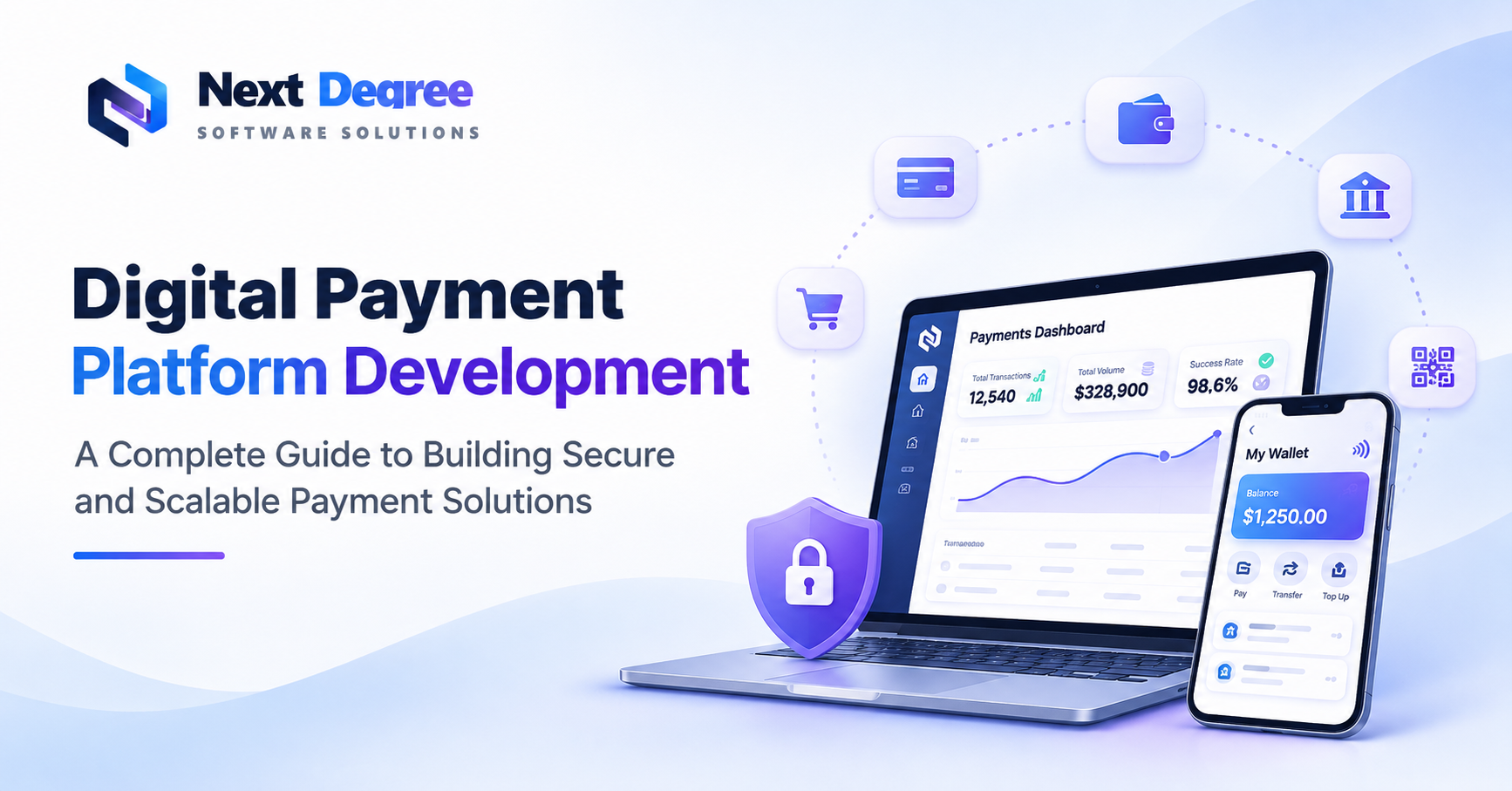
Digital Payment Platform Development: A Complete Guide to Building Secure and Scalable Payment Solutions
Digital payments have transformed how businesses and customers exchange money. From online shopping and mobile banking to digital wallets and subscription services, electronic transactions have become an essential part of everyday financial activities.
As businesses increasingly rely on digital financial services, the demand for reliable, secure, and convenient payment technologies continues to shape modern software development.
This is where digital payment platform development plays a critical role.
Building a payment platform involves much more than enabling customers to complete online transactions. It requires secure software architecture, payment processing integrations, financial data protection, intuitive user experiences, and reliable transaction management.
Whether an organization is launching a fintech startup, developing a digital wallet, or integrating payment functionality into an existing application, understanding the development process is essential.
In this guide, we explore digital payment platform development, its business benefits, essential features, technical architecture, development stages, security requirements, and practical considerations for building dependable financial technology solutions.
What Is Digital Payment Platform Development?
Digital payment platform development is the process of designing, building, integrating, and maintaining software systems that enable electronic financial transactions.
These platforms allow individuals and businesses to initiate, process, monitor, and manage payments through digital channels.
Depending on their purpose, payment platforms may support debit and credit cards, bank transfers, digital wallets, recurring payments, and other electronic payment methods.
Digital payment solutions commonly include several components:
- Payment gateways: Technologies that securely transmit payment information between merchants and payment service providers.
- Digital wallets: Applications that enable users to manage supported payment methods, balances, or payment credentials.
- Payment processing systems: Infrastructure responsible for coordinating payment transactions and their outcomes.
- Merchant payment platforms: Systems that help businesses accept payments and monitor financial activities.
- Subscription billing systems: Solutions that support recurring payments and automated billing workflows.
Although these components may operate together, their functions and regulatory responsibilities differ.
The appropriate architecture depends on the business model, supported payment methods, financial partners, and target markets.
Why Is Digital Payment Platform Development Important for Businesses?
Professional payment software development can help organizations improve financial operations and create more convenient customer experiences.
1. Improving Payment Convenience
Customers increasingly expect payment experiences that are straightforward and compatible with their preferred methods.
A well-designed payment platform can simplify checkout processes, reduce unnecessary steps, and support transactions across different devices.
By making payment interactions easier to understand, businesses can reduce friction during important customer journeys.
2. Supporting Operational Efficiency
Manual payment reconciliation and fragmented transaction records can create administrative challenges.
Digital payment platforms can automate transaction tracking, payment notifications, refund workflows, and financial reporting.
These capabilities help finance and operations teams manage payment activities more efficiently.
3. Enabling Business Scalability
As transaction volumes increase, businesses need payment infrastructure capable of handling growing workloads.
A scalable architecture can support additional users, merchants, payment methods, and integrations without requiring a complete system redesign.
However, scalability must be supported by appropriate testing, infrastructure monitoring, and reliable transaction processing.
4. Supporting Digital Business Models
Digital payment platforms enable organizations to introduce services such as recurring subscriptions, marketplace transactions, online purchases, and mobile payment experiences.
For fintech companies, payment technology may also form the foundation of specialized financial products.
5. Strengthening Customer Confidence
Trust is especially important when users share financial information or authorize transactions.
Clear payment confirmations, transparent transaction histories, secure authentication, and reliable support processes contribute to a more trustworthy payment experience.
Essential Features of a Digital Payment Platform
The required functionality depends on the platform's business model, but several features are common across professional payment solutions.
Secure User Authentication
Authentication helps verify user identities before allowing access to sensitive accounts or payment functions.
Depending on the application and applicable requirements, security measures may include multifactor authentication, biometric authentication, secure session management, and risk-based verification.
Authentication should be supported by appropriate authorization controls that limit what each user can access or perform.
Multiple Payment Methods
Supporting several payment methods can make a platform more accessible to different customer groups.
Examples include payment cards, bank transfers, supported mobile wallets, and locally available payment networks.
The specific methods offered depend on the platform's payment partners, location, and regulatory eligibility.
Transaction Management
A payment platform should provide reliable mechanisms for creating, tracking, confirming, and reconciling transactions.
Important functions may include transaction histories, payment status updates, refunds, notifications, and administrative reporting.
Digital Wallet Functionality
Digital wallet development may include stored payment credentials, transaction histories, transfers, and account management.
Platforms that maintain customer funds or stored monetary value require additional financial, operational, and regulatory considerations.
Reporting and Analytics
Dashboards can help merchants and administrators monitor transaction volumes, payment failures, refunds, and operational performance.
These insights support informed financial and technical decisions.
The Digital Payment Platform Development Process
Successful payment platform development requires a structured approach that addresses business requirements, financial infrastructure, security, and operational reliability.
Step 1: Define Business and Regulatory Requirements
Development begins by identifying the platform's target audience, payment methods, transaction flows, and business objectives.
Teams must also determine which financial activities the platform will perform directly and which will be handled by licensed payment partners.
Regulatory requirements should be evaluated before architectural decisions are finalized.
Step 2: Plan the Payment Architecture
The architecture defines how the application interacts with payment gateways, financial institutions, databases, authentication services, and external APIs.
Developers should consider transaction consistency, system availability, scalability, error handling, and data protection.
A clear architectural design helps reduce operational complexity as the platform grows.
Step 3: Design the User Experience
Payment interfaces should be understandable, accessible, and transparent.
Users need clear information about payment amounts, transaction statuses, applicable fees, and confirmation steps.
Good UI/UX design also addresses failed transactions, interrupted payments, and refund requests.
These situations are particularly important because payment uncertainty can reduce user confidence.
Step 4: Develop and Integrate Core Functionality
During development, engineers implement application interfaces, server-side functionality, transaction services, administrative controls, and integrations.
Payment APIs connect the platform with appropriate payment processors and financial service providers.
Integration design should account for authentication, transaction references, asynchronous notifications, and reliable error handling.
Step 5: Test Security and Transaction Reliability
Payment applications require comprehensive testing before launch.
Testing should cover payment success and failure scenarios, duplicate requests, interrupted connections, refunds, authorization controls, and system performance.
Security assessments and integration tests help identify vulnerabilities and operational weaknesses.
Step 6: Deploy, Monitor, and Maintain
Following testing and any required operational approvals, the platform can be deployed.
Monitoring should track transaction errors, service availability, suspicious activity, API performance, and reconciliation discrepancies.
Ongoing maintenance is necessary to address vulnerabilities, improve functionality, and support changing payment requirements.
Technology and Architecture Considerations
Digital payment systems combine several technologies to deliver reliable financial interactions.
Front-end development may use React, Angular, Vue.js, or mobile development technologies to create customer and merchant interfaces.
Back-end development commonly involves technologies such as Java, .NET, Node.js, or Python.
Databases manage transaction records, account information, operational events, and other application data.
Cloud infrastructure can provide scalable computing resources, monitoring capabilities, and managed services.
APIs and payment integrations enable communication with payment processors, banking partners, and other authorized financial systems.
Technology selection should prioritize security, transactional correctness, maintainability, and operational reliability rather than popularity alone.
Security and Compliance in Payment Platform Development
Security is one of the most important considerations in financial technology.
Payment platforms should apply appropriate encryption, authentication, access management, monitoring, and secure software development practices.
Where payment card account data is involved, the Payment Card Industry Data Security Standard (PCI DSS) establishes relevant technical and operational security requirements.
Tokenization may also help reduce exposure to sensitive payment information when implemented appropriately.
In addition, payment APIs require protection against unauthorized access, insecure configurations, and weaknesses in authorization mechanisms.
Compliance requirements vary depending on jurisdiction, payment methods, data handling, and the platform's role in financial transactions.
For example, a company integrating a licensed payment gateway may have different obligations from an organization directly providing regulated payment services.
Businesses should therefore evaluate regulatory responsibilities with qualified specialists before launching financial functionality.
Common Challenges in Digital Payment Platform Development
Transaction Reliability
Payment systems must handle timeouts, duplicate requests, network interruptions, and delayed confirmations.
Developers can improve reliability through idempotency controls, transaction state management, reconciliation processes, and appropriate retry mechanisms.
These controls help reduce the risk of duplicate processing and inconsistent transaction records.
Fraud Prevention
Payment platforms may face unauthorized transactions, account takeover attempts, and suspicious financial activity.
Depending on the business model, fraud prevention may involve transaction monitoring, identity verification, risk scoring, and additional authentication.
Integration Complexity
Different payment providers may offer different API structures, settlement processes, error responses, and operational requirements.
Well-defined integration layers and comprehensive testing help manage this complexity.
Regulatory Requirements
Financial services are subject to rules that vary between markets.
Licensing, customer verification, data protection, and payment processing obligations should be considered early in the project.
Performance and Scalability
Growing transaction volumes require effective database management, infrastructure planning, and performance monitoring.
Scalability decisions should be supported by realistic workload testing.
How Much Does Digital Payment Platform Development Cost?
The cost of digital payment platform development depends on several factors.
These include platform complexity, supported payment methods, custom integrations, digital wallet functionality, security controls, compliance requirements, and expected transaction volumes.
A payment integration for an existing e-commerce application generally has different requirements from a custom payment gateway or a digital wallet platform.
Organizations should also account for ongoing expenses, including cloud infrastructure, payment provider fees, monitoring, maintenance, security assessments, and regulatory obligations.
Defining a clear project scope and identifying necessary financial partnerships provides a more reliable basis for cost estimation.
How to Choose the Right Payment Platform Development Partner
Selecting a development partner requires evaluating both software engineering capabilities and experience with financial transaction systems.
Businesses should assess a provider's understanding of payment APIs, security architecture, transaction reliability, cloud infrastructure, and user experience.
It is equally important to discuss regulatory responsibilities, testing procedures, technical documentation, and post-launch support.
At Next Degree Software Solutions, we recognize that effective payment platform development requires more than implementing transaction functionality.
It involves connecting business objectives with secure architecture, intuitive interfaces, and dependable software operations.
A carefully planned development strategy can help organizations create payment solutions that support their customers and evolving business requirements.
Conclusion: Building Reliable Digital Payment Experiences
Digital payment platform development is an important part of modern financial technology, enabling businesses to create convenient electronic payment experiences and support increasingly digital operations.
Successful payment platforms require more than attractive interfaces and basic payment integrations. They depend on secure architecture, reliable transaction management, appropriate compliance planning, and continuous operational improvement.
By defining clear requirements, selecting suitable financial partners, and prioritizing security and scalability, organizations can develop payment solutions that support long-term business needs.
Ready to develop a secure digital payment platform or wallet solution?
Connect with Next Degree Software Solutions to discuss your payment platform requirements and explore a development approach aligned with your business goals.
SaaS Application Development: A Complete Guide to Building Scalable Cloud-Based Solutions
Custom CRM Development: A Complete Guide to Building Smarter Customer Relationships
ERP Software Development: A Complete Guide to Building Smarter Business Management Systems
Best Practices for Website Development: A Complete Guide to Building High-Performing Websites
Digital Solutions: A Complete Guide for Modern Businesses
UI/UX Design Services: A Complete Guide to Creating Successful Digital Products
Web Development | Complete Business Guide for 2026
Website Development: A Complete Guide for Businesses
Enterprise Software Development: A Complete Guide for Modern Businesses
Custom Software Development Cost in 2026: Complete Guide